
Reason Code List / Mastercard / Reason Code 4834
DESCRIPTION
Why did I receive a chargeback with reason code 4834?
You received this chargeback because you made a mistake — or the cardholder alleges you made a mistake — while processing the transaction.
There are several different point-of-interaction errors that could trigger a chargeback with this reason code. To better manage the various causes of chargebacks, Mastercard has created several reason code subcategories and nested them under this general, overarching reason code.
Check our other guides to learn more about specific POI errors that can cause this type of chargeback.
- 4834 – ATM Funds Not Dispensed
- 4834 – Cardholder Debited More than Once for the Same Goods or Services
- 4834 – Cash Was Not Properly Provided
- 4834 – Charges for Loss, Theft, or Damages
- 4834 – Currency Errors
- 4834 – Improper Merchant Surcharge
- 4834 – Merchant Refund Correcting Error Resulted in Cardholder Currency Exchange Loss
- 4834 – Transaction Amount Differs
- 4834 – Unreasonable Amount
There are a couple of additional reason codes that may be used for point-of-interaction error chargebacks. However, these reason codes will be restructured in 2028 or eventually retired. For the time being, an issuer can technically still use them, but Mastercard encourages issuers to transition to the above mentioned codes instead.
- 4831 – Transaction Amount Differs
- 4846 – Correct Transaction Currency Code Not Provided
Need help managing Mastercard 4834 chargebacks?
Let AltoShield help you create a comprehensive chargeback management strategy that can lower risk, reduce costs, boost approvals, and improve processing sustainability.
CLASSIFICATION
How does Mastercard classify this dispute?
Mastercard has two transaction processing workflows: dual message and single message.
Reason code 4834 is for the dual message system. The single message equivalent is reason code 34. While the codes are different, the rules and processes are generally the same for both dual message and single message.
ISSUER TIME LIMIT
How long can the issuer wait to file a chargeback with reason code 4834?
In most regions and situations, issuers must file POI error chargebacks within 90 days of the transaction processing date.
TRANSLATION
What language can the issuer use for a 4834 chargeback?
If the issuer and acquirer do not share a common language, all relevant non-English documents must be accompanied by an English version.
If the issuer and acquirer do share a common language, an English translation of the documents is not necessary for most regions (Brazil is an exception) during the chargeback and second presentment stage of the transaction lifecycle. However, an English translation will be needed if the issuer advances the case to pre-arbitration and the acquirer responds.
If a translation is required but not provided, Mastercard will likely rule against the non-compliant party.
SECOND PRESENTMENT
Can I fight a chargeback with reason code 4834?
Yes, you can respond to a point-of-interaction error chargeback. The process is called second presentment or representment.
Each subcategory has its own response requirements.
Visit the page for your specific subcategory to learn more.
- ATM Funds Not Dispensed
- Cardholder Debited More than Once for the Same Goods or Services
- Cash Was Not Properly Provided
- Charges for Loss, Theft, or Damages
- Currency Errors
- Improper Merchant Surcharge
- Merchant Refund Correcting Error Resulted in Cardholder Currency Exchange Loss
- Transaction Amount Differs
- Unreasonable Amount
If you provide supporting documentation with your second presentment, do not include the cardholder’s full account number (PAN).
ACQUIRER TIME LIMIT
How quickly do I need to file a chargeback response?
Response timelines vary by subcategory and region. Generally — in most regions and for most subcategories — responses must be submitted to the issuer within 45 days of the chargeback processing date.
There are a few timeline exceptions. The following countries have alternate time limits in certain situations — either 10, 20, or 30 days instead of 45.
- Costa Rica
- Kazakhstan
- Mainland China
- Nigeria
- Poland
- Tanzania
NOTE: This time limit is for the acquirer — not you, the merchant. Merchant time limits are usually much shorter. Review your chargeback notice or check with your acquirer to find out how long you have to respond.
ADVANCING THE CASE
Are pre-arbitration and arbitration an option for reason code 4834?
Yes, pre-arbitration and arbitration are an option for Mastercard reason code 4834 point-of-interaction error chargebacks.
Here is an overview of the full Mastercard dispute lifecycle and which entity is responsible for each filing.
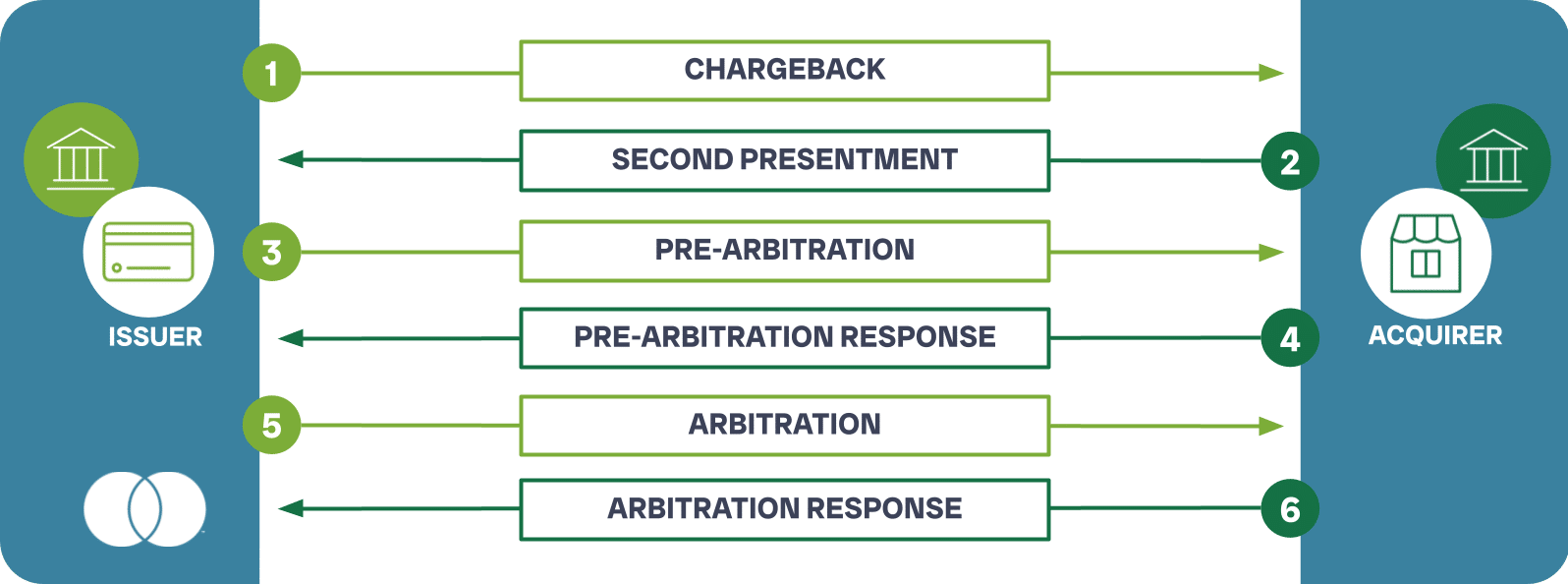
Check our Mastercard pre-arbitration and arbitration guide to learn more.
Changing the chargeback reason code
In certain situations, an issuer can change a chargeback’s reason code during the pre-arbitration process.
An issuer can change from a non-POI error chargeback to a POI error chargeback when appropriate and all of the following are true.
- The original chargeback was valid.
- A second presentment remedied the original chargeback, but the issuer identified that a 4834 chargeback is applicable.
PREVENT
How can I avoid chargebacks like this in the future?
Here are steps you can take to avoid Mastercard reason code 4834 in the future.
- Clearly explain the situations that might cause you to charge the card including charges for loss, theft, or damage.
- If you need to charge for loss, theft, or damage, process two transactions — the first for the initial service and the second for the additional fee.
- Have the cardholder read and agree to your terms and policies before processing the original transaction.
- Don’t automatically apply dynamic currency conversion (DCC) to transactions. Give customers the option to select the service if they are interested, but don’t require its use.
- Have systems in place to manage multiple currencies. Make sure staff are trained on procedures.
- Understand Mastercard’s rules for surcharges. Know when and how a surcharge can be applied.
- Make sure your surcharge strategy is dynamic and can adjust for region-specific requirements.
- Always fix processing errors with a reversal instead of a refund.
- Never change the amount of a completed transaction without the cardholder’s consent.
- Use caution when entering handwritten transaction information.
- Always swipe or dip a card — only use fallback options in emergency situations.
- If you notice a duplicate transaction, reverse the transaction or issue a credit as soon as possible.
- Only send batches one time.
- If the customer wants to change to a different form of payment after initially offering the payment card, be sure to void the charge.
- If you don’t know the final transaction amount before goods or services will be provided, give the cardholder an accurate estimate of the transaction amount before charging the card. Make sure the transaction amount is reasonable based on previous bills and the relevant circumstances of services provided.
- If you manage an ATM, be sure to reconcile your ATM promptly. Adjust it if it is out-of-balance. And process a credit as soon as possible if you notice a discrepancy in the amount dispersed.
Want additional chargeback prevention tips? Check our detailed guide.
NOTE
Mastercard chargeback rules are complex. The guide is over 1,500 pages long — compared to 67 pages for Visa — and contains detailed rules for both issuers and acquirers.
In an attempt to simplify the complex, we are only sharing information that is most relevant to merchants. If you are an acquirer and in need of more details, reach out to our team. We’d be happy to walk through the specifics with you.
DESCRIPTION
Why did I receive a chargeback with reason code 4834?
You received this chargeback because you made a mistake — or the cardholder alleges you made a mistake — while processing the transaction.
There are several different point-of-interaction errors that could trigger a chargeback with this reason code. To better manage the various causes of chargebacks, Mastercard has created several reason code subcategories and nested them under this general, overarching reason code.
Check our other guides to learn more about specific POI errors that can cause this type of chargeback.
- 4834 – ATM Funds Not Dispensed
- 4834 – Cardholder Debited More than Once for the Same Goods or Services
- 4834 – Cash Was Not Properly Provided
- 4834 – Charges for Loss, Theft, or Damages
- 4834 – Currency Errors
- 4834 – Improper Merchant Surcharge
- 4834 – Merchant Refund Correcting Error Resulted in Cardholder Currency Exchange Loss
- 4834 – Transaction Amount Differs
- 4834 – Unreasonable Amount
There are a couple of additional reason codes that may be used for point-of-interaction error chargebacks. However, these reason codes will be restructured in 2028 or eventually retired. For the time being, an issuer can technically still use them, but Mastercard encourages issuers to transition to the above mentioned codes instead.
- 4831 – Transaction Amount Differs
- 4846 – Correct Transaction Currency Code Not Provided
Need help managing Mastercard 4834 chargebacks?
Let AltoShield help you create a comprehensive chargeback management strategy that can lower risk, reduce costs, boost approvals, and improve processing sustainability.
CLASSIFICATION
How does Mastercard classify this dispute?
Mastercard has two transaction processing workflows: dual message and single message.
Reason code 4834 is for the dual message system. The single message equivalent is reason code 34. While the codes are different, the rules and processes are generally the same for both dual message and single message.
ISSUER TIME LIMIT
How long can the issuer wait to file a chargeback with reason code 4834?
In most regions and situations, issuers must file POI error chargebacks within 90 days of the transaction processing date.
TRANSLATION
What language can the issuer use for a 4834 chargeback?
If the issuer and acquirer do not share a common language, all relevant non-English documents must be accompanied by an English version.
If the issuer and acquirer do share a common language, an English translation of the documents is not necessary for most regions (Brazil is an exception) during the chargeback and second presentment stage of the transaction lifecycle. However, an English translation will be needed if the issuer advances the case to pre-arbitration and the acquirer responds.
If a translation is required but not provided, Mastercard will likely rule against the non-compliant party.
SECOND PRESENTMENT
Can I fight a chargeback with reason code 4834?
Yes, you can respond to a point-of-interaction error chargeback. The process is called second presentment or representment.
Each subcategory has its own response requirements.
Visit the page for your specific subcategory to learn more.
- ATM Funds Not Dispensed
- Cardholder Debited More than Once for the Same Goods or Services
- Cash Was Not Properly Provided
- Charges for Loss, Theft, or Damages
- Currency Errors
- Improper Merchant Surcharge
- Merchant Refund Correcting Error Resulted in Cardholder Currency Exchange Loss
- Transaction Amount Differs
- Unreasonable Amount
If you provide supporting documentation with your second presentment, do not include the cardholder’s full account number (PAN).
ACQUIRER TIME LIMIT
How quickly do I need to file a chargeback response?
Response timelines vary by subcategory and region. Generally — in most regions and for most subcategories — responses must be submitted to the issuer within 45 days of the chargeback processing date.
There are a few timeline exceptions. The following countries have alternate time limits in certain situations — either 10, 20, or 30 days instead of 45.
- Costa Rica
- Kazakhstan
- Mainland China
- Nigeria
- Poland
- Tanzania
NOTE: This time limit is for the acquirer — not you, the merchant. Merchant time limits are usually much shorter. Review your chargeback notice or check with your acquirer to find out how long you have to respond.
ADVANCING THE CASE
Are pre-arbitration and arbitration an option for reason code 4834?
Yes, pre-arbitration and arbitration are an option for Mastercard reason code 4834 point-of-interaction error chargebacks.
Here is an overview of the full Mastercard dispute lifecycle and which entity is responsible for each filing.
Check our Mastercard pre-arbitration and arbitration guide to learn more.
Changing the chargeback reason code
In certain situations, an issuer can change a chargeback’s reason code during the pre-arbitration process.
An issuer can change from a non-POI error chargeback to a POI error chargeback when appropriate and all of the following are true.
- The original chargeback was valid.
- A second presentment remedied the original chargeback, but the issuer identified that a 4834 chargeback is applicable.
PREVENT
How can I avoid chargebacks like this in the future?
Here are steps you can take to avoid Mastercard reason code 4834 in the future.
- Clearly explain the situations that might cause you to charge the card including charges for loss, theft, or damage.
- If you need to charge for loss, theft, or damage, process two transactions — the first for the initial service and the second for the additional fee.
- Have the cardholder read and agree to your terms and policies before processing the original transaction.
- Don’t automatically apply dynamic currency conversion (DCC) to transactions. Give customers the option to select the service if they are interested, but don’t require its use.
- Have systems in place to manage multiple currencies. Make sure staff are trained on procedures.
- Understand Mastercard’s rules for surcharges. Know when and how a surcharge can be applied.
- Make sure your surcharge strategy is dynamic and can adjust for region-specific requirements.
- Always fix processing errors with a reversal instead of a refund.
- Never change the amount of a completed transaction without the cardholder’s consent.
- Use caution when entering handwritten transaction information.
- Always swipe or dip a card — only use fallback options in emergency situations.
- If you notice a duplicate transaction, reverse the transaction or issue a credit as soon as possible.
- Only send batches one time.
- If the customer wants to change to a different form of payment after initially offering the payment card, be sure to void the charge.
- If you don’t know the final transaction amount before goods or services will be provided, give the cardholder an accurate estimate of the transaction amount before charging the card. Make sure the transaction amount is reasonable based on previous bills and the relevant circumstances of services provided.
- If you manage an ATM, be sure to reconcile your ATM promptly. Adjust it if it is out-of-balance. And process a credit as soon as possible if you notice a discrepancy in the amount dispersed.
Want additional chargeback prevention tips? Check our detailed guide.
NOTE
Mastercard chargeback rules are complex. The guide is over 1,500 pages long — compared to 67 pages for Visa — and contains detailed rules for both issuers and acquirers.
In an attempt to simplify the complex, we are only sharing information that is most relevant to merchants. If you are an acquirer and in need of more details, reach out to our team. We’d be happy to walk through the specifics with you.
PUBLISHED ON: October 13, 2026

WRITTEN BY: Jessica Velasco