



On 28 July 2026, Mastercard announced a new strategy for monitoring fraud and chargebacks — including the launch of the Global Merchant Audit Program (GMAP) .
In this article, you’ll find a detailed yet simplified explanation of the announcement and advice on how to respond.
NOTE
Mastercard’s latest announcement is long, detailed, and confusing. In fact, it might be the most complex announcement we’ve ever encountered.
We have been working through multiple questions with the Mastercard team. Our understanding and insights on the topic is evolving as more information becomes available.
We recommend following AltoPay on LinkedIn so you’ll be the first to know about new developments.
RELATED READING
Want to learn more about the general GMAP announcement? Check our GMAP announcement article. You can also check out our other articles about QMAP and potential scam merchants — related but different monitoring programs.
TL;DR
A high-level overview
The GMAP announcement contains several important details. Here’s a high-level overview of what is being updated.
The Global Merchant Audit Program (GMAP) is a Mastercard initiative to detect, monitor, and minimise risk resulting from fraud and chargebacks. It is used to critique both merchant and acquirer performance.
GMAP includes key performance indicators (KPIs), each with designated thresholds. Breaching those thresholds means the merchant or acquirer is identified by the program and eligible for program fees. Enrolled merchants and acquirers can exit the program when they keep their metrics below thresholds for three consecutive months.
GMAP monitors risk similarly to VAMP.
Like Visa, Mastercard legacy programs monitored fraud and chargebacks separately. But GMAP combines the two threats into one measurement like VAMP does. Mastercard wants to incorporate “both confirmed fraud activity — including fraud not resulting in a chargeback — and non-fraud dispute activity into a unified view of overall performance.
But unlike VAMP, GMAP doesn’t double dip. GMAP has a threshold for fraud claims (SAFE data) plus non-fraud chargebacks. Even if a fraud claim does trigger a chargeback, the dispute is only counted once.
GMAP does three things:
- The legacy framework for acquirer monitoring — the Acquirer Chargeback Monitoring Program (ACMP) — has been retired and incorporated into GMAP.
- Multiple subprograms have been created within the overarching GMAP to establish guidelines at both the merchant and acquirer level.
- Certain thresholds can now be monitored on the submerchant ID level. This allegedly allows PayFacs to more fairly and accurately monitor risk for individual merchants.
GMAP is a global standard, meaning merchants and acquirers in all regions are eligible for identification.
Mastercard plans to update its technology platform with required data elements by October 2026. This will give acquirers time to start building their monitoring strategy.
However, the initial GMAP standards won’t take effect until 1 April 2027. The first GMAP billing will take place in May 2027 for April 2027 violations.
Certain thresholds will be further revised on 1 January 2029, 1 January 2030, and 1 January 2031.
How does GMAP work?
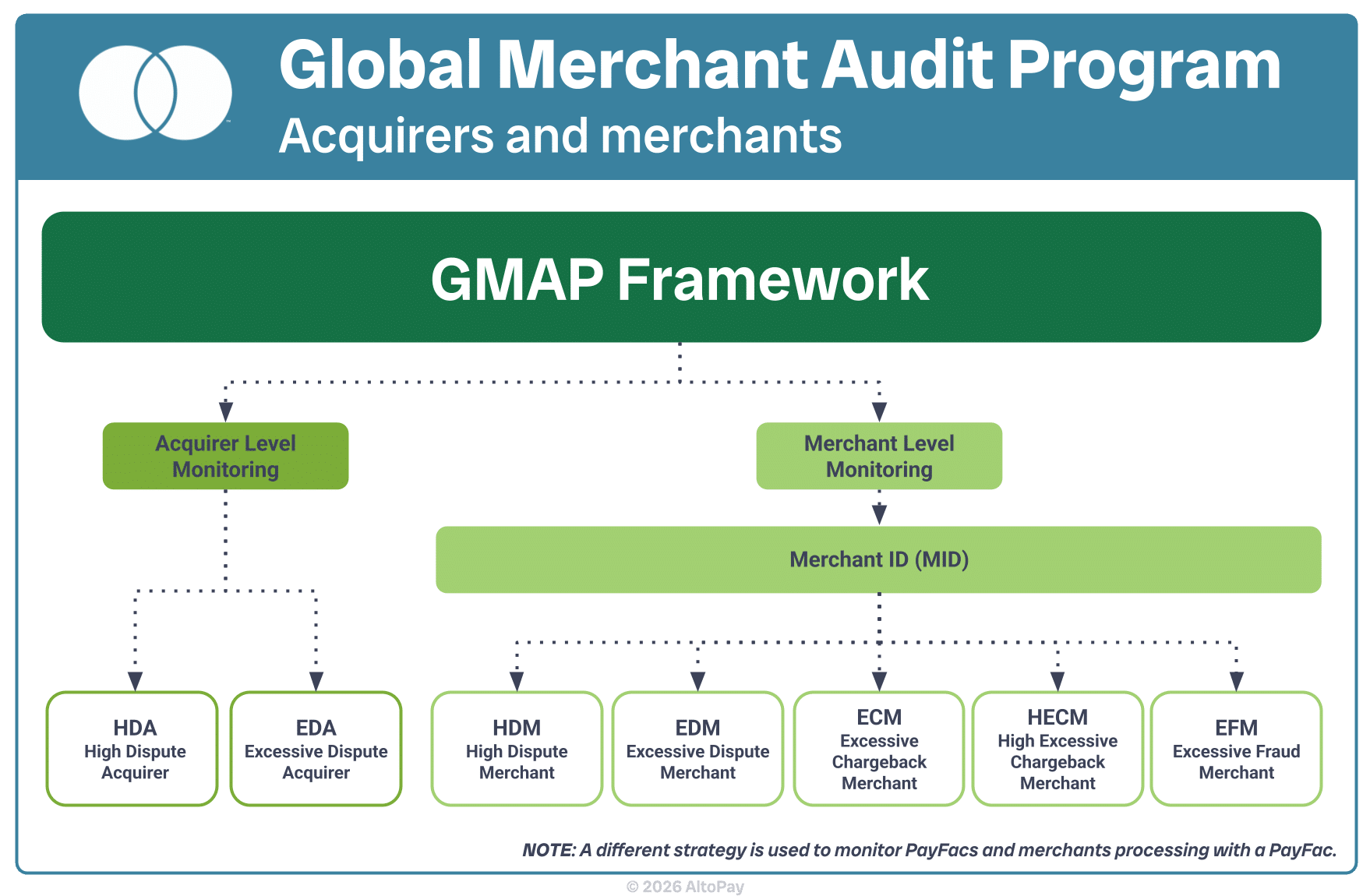
GMAP is a framework of different subcategories that apply to different audiences: acquirers and merchants.
NOTE
The GMAP update introduced new monitoring standards for PayFacs and their merchants. If you are a PayFac or use a PayFac to process payments, jump ahead to this section of our article.
Acquirer-level subcategories are:
Merchant-level subcategories are:
Each subcategory monitors its own metrics with set thresholds.
If a member — acquirer or merchant — breaches the thresholds outlined in its respective subcategory, a GMAP assessment will be launched and penalties may apply.
What are the GMAP fraud and chargeback thresholds?
Each subcategory has its own thresholds. Let’s take a look at each.
High Dispute Acquirer (HDA) thresholds and fines
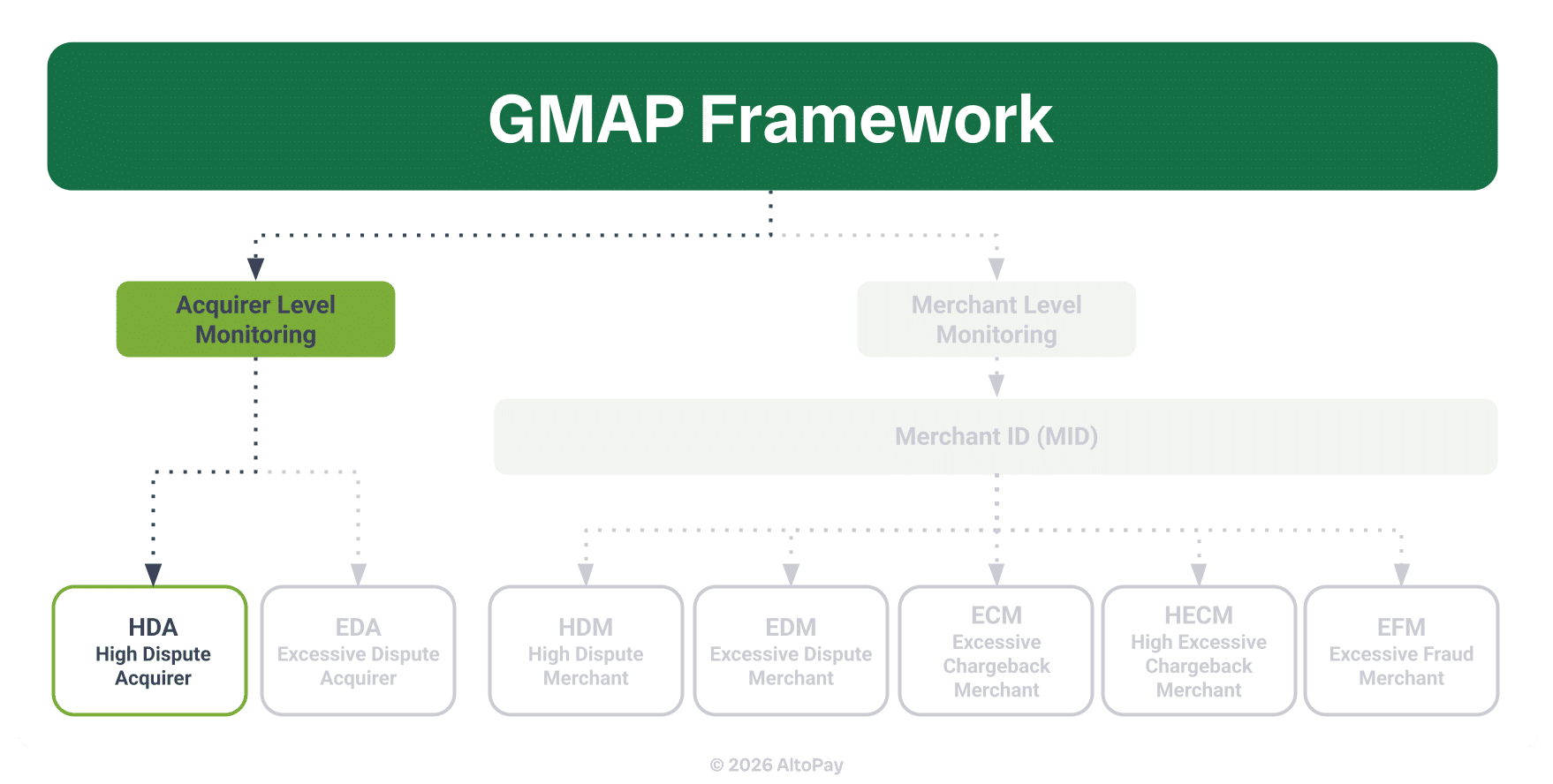
An acquirer is identified as a High Dispute Acquirer when there are elevated fraud and dispute levels across its merchant portfolio.
These are the thresholds. Breaching all of these in a single month triggers an HDA audit.
- 1,500 or more transactions
- 1,500 or more transactions with a corresponding fraud claim (SAFE data) and/or non-fraud chargeback
- 0.5% or higher GMAP ratio (percent of fraud claims plus non-fraud chargebacks received in the current month compared to sales from the previous month)
Fees will be assessed each month the acquirer is in the program.
| MONTH | FEE |
|---|---|
| Months 1 - 11 | $0 USD monthly |
| Months 12 - 18 | $25,000 USD monthly |
| Months 19+ | $50,000 USD monthly |
Excessive Dispute Acquirer (EDA) thresholds and fines
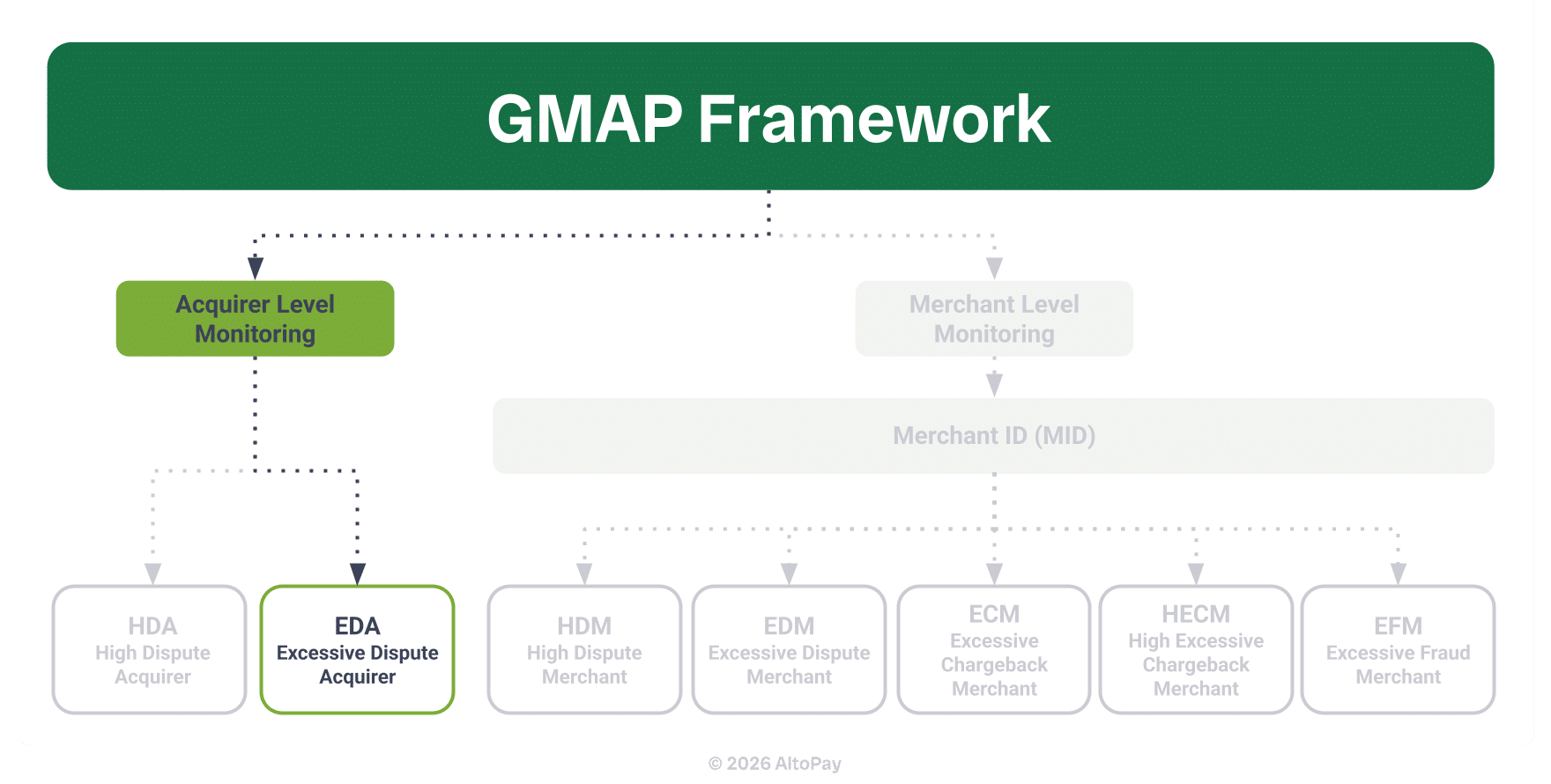
An acquirer is identified as an Excessive Dispute Acquirer when its portfolio experiences sustained and excessive performance concerns requiring escalated action.
These are the thresholds. Breaching all of these in a single month triggers an EDA audit.
- 1,500 or more transactions
- 1,500 or more transactions with a corresponding fraud claim (SAFE data) and/or non-fraud chargeback
- 0.7% or higher GMAP ratio (percent of fraud claims plus non-fraud chargebacks received in the current month compared to sales from the previous month)
Fees will be assessed each month the acquirer is in the program.
| MONTH | FEE |
|---|---|
| Months 1 - 2 | $0 USD monthly |
| Months 3 - 6 | $10,000 USD monthly |
| Months 7 - 11 | $25,000 USD monthly |
| Months 12 - 18 | $50,000 USD monthly |
| Months 19+ | $100,000 USD monthly |
Acquirers that remain non-compliant for 12 or more months may need to complete a Franchise Management Program (FMP) review at their expense and address any identified issues.
Acquirers remaining non-compliant for 19 or more months could receive additional penalties, including potential restrictions, suspension, or termination of their Mastercard license.
NOTE
Later in this article, we’ll explain what is required to exit the program. But we’ll make a brief note here.
An acquirer will remain in GMAP until fraud and chargeback activity drops below the stated thresholds and remains compliant for at least three consecutive months. Because fees are triggered at month 3, an EDA classification will cost — at the very least — $10,000.
High Dispute Merchant (HDM) thresholds and fines
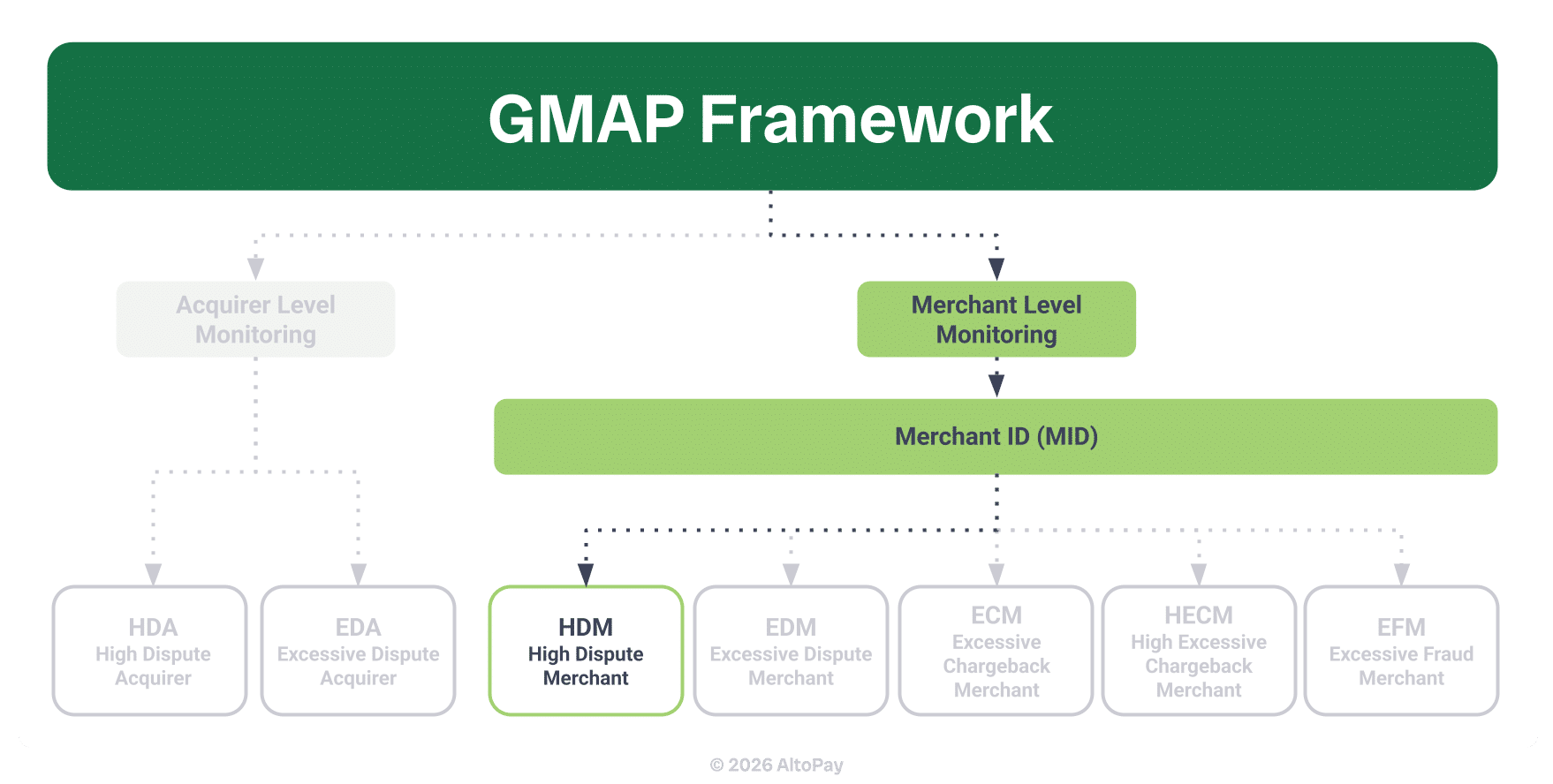
A merchant is classified as a High Dispute Merchant (HDM) when there are elevated levels of fraud and chargebacks which could indicate increased cardholder risk or transaction quality concerns.
These are the thresholds. Breaching all of these in a single month triggers an HDM audit.
- 5 or more transactions
- $5,000 USD or more in fraud claims (SAFE data) and/or non-fraud chargebacks
- 5% or higher GMAP ratio (percent of fraud claims plus non-fraud chargebacks received in the current month compared to sales from the previous month)
Fees are assessed each month the merchant is in the program.
| MONTH | FEE |
|---|---|
| Months 1 to 6 | $0 USD monthly |
| Months 7 to 11 | $5,000 USD monthly |
| Months 12 to 18 | $10,000 USD monthly |
| Months 19+ | $25,000 USD monthly |
If a merchant exceeds HDM thresholds for two or more consecutive months, Mastercard may notify issuers of the merchant’s elevated risk level.
Although not in the official announcement, we can assume this issuer notification may cause the merchant’s authorisation rates to drop.
Another detail that isn’t specified in the announcement is whether or not Mastercard will notify issuers when the merchant exits the program or if the issuer’s perception of the merchant will forever be damaged.
Excessive Dispute Merchant (EDM) thresholds and fines
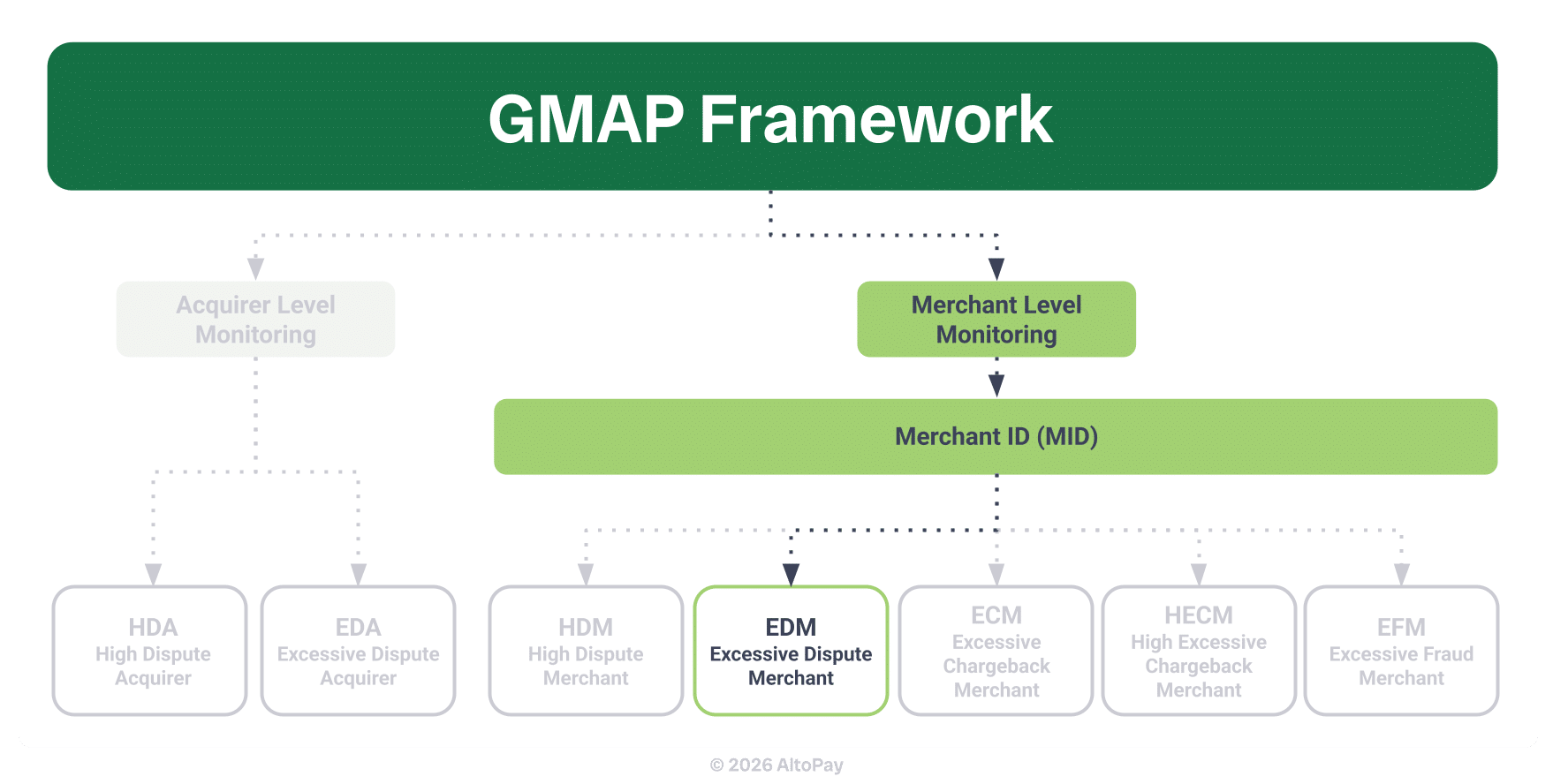
A merchant will be classified as an Excessive Dispute Merchant (EDM) if fraud and chargeback levels are elevated for a sustained period of time.
These are the thresholds. Breaching all of these in a single month triggers an EDM audit.
- 5 or more transactions
- $10,000 USD or more in fraud claims (SAFE data) and/or non-fraud chargebacks
- 50% or higher GMAP ratio (percent of fraud claims plus non-fraud chargebacks received in the current month compared to sales from the previous month)
Fees are assessed each month the merchant is in the program.
| MONTH | FEE |
|---|---|
| Month 1 | $5,000 USD monthly |
| Month 2 | $25,000 USD monthly |
| Months 3 - 11 | $100,000 USD monthly |
| Months 12 - 18 | $200,000 USD monthly |
| Months 19+ | $300,000 USD monthly |
When a merchant exceeds EDM thresholds for two consecutive months, liability for fraud-related chargebacks will shift to the merchant. This pertains to any fraud-related chargeback filed during the three months prior to identification and any fraud-related chargebacks occurring during the six months after identification.
When liability shifts, issuers can use chargeback reason code 4849 (Questionable Merchant) instead of a regular fraud reason code. This allows issuers to file chargebacks without any supporting documents and revokes merchant representment rights.
Excessive Chargeback Merchant (ECM) thresholds and fines
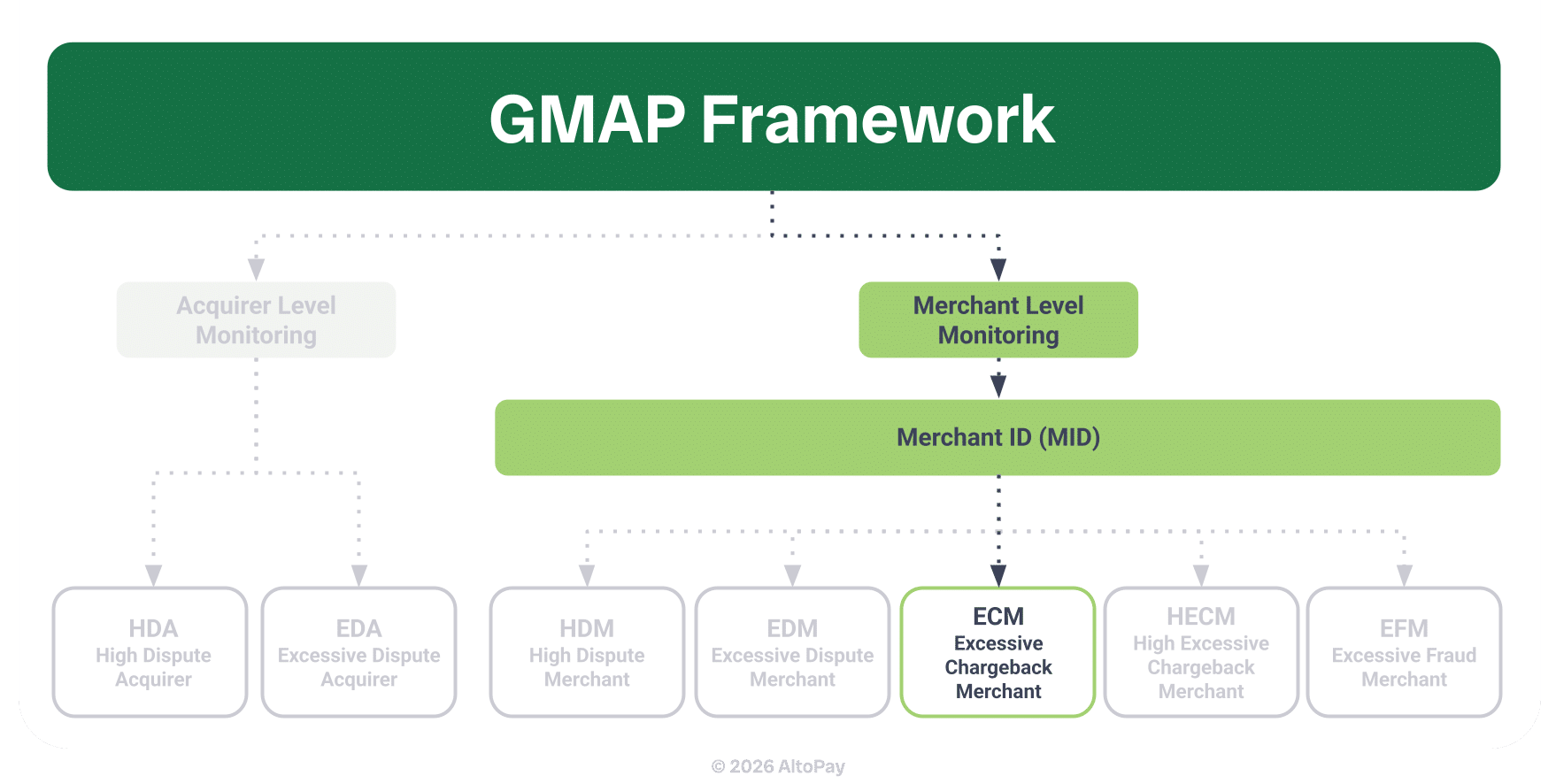
Merchants are classified as an Excessive Chargeback Merchant when chargeback activity starts to escalate.
When the GMAP standards go into effect on 1 April 2027, these will be the thresholds. Breaching all of these in a single month triggers an ECM audit.
- 25 or more transactions
- 100 or more chargebacks
- 1.5% or higher chargeback-to-transaction ratio (percent of chargebacks received in the current month compared to sales from the previous month)
ECM thresholds will be lowered on three future dates.
- 1 January 2029 – The chargeback-to-transaction ratio will be lower to 1.30%
- 1 January 2030 – The chargeback-to-transaction ratio will be lower to 1.10%
- 1 January 2031 – The chargeback-to-transaction ratio will be lower to 0.9%
Fees are assessed each month the merchant is in the program.
| MONTH | FEE |
|---|---|
| Month 1 | $0 USD monthly |
| Months 2 - 3 | $1,000 USD monthly |
| Months 4 - 6 | $5,000 USD monthly |
| Months 7 - 11 | $25,000 USD monthly |
| Months 12 - 18 | $50,000 USD monthly |
| Months 19+ | $100,000 USD monthly |
High Excessive Chargeback Merchant (HECM) thresholds and fines
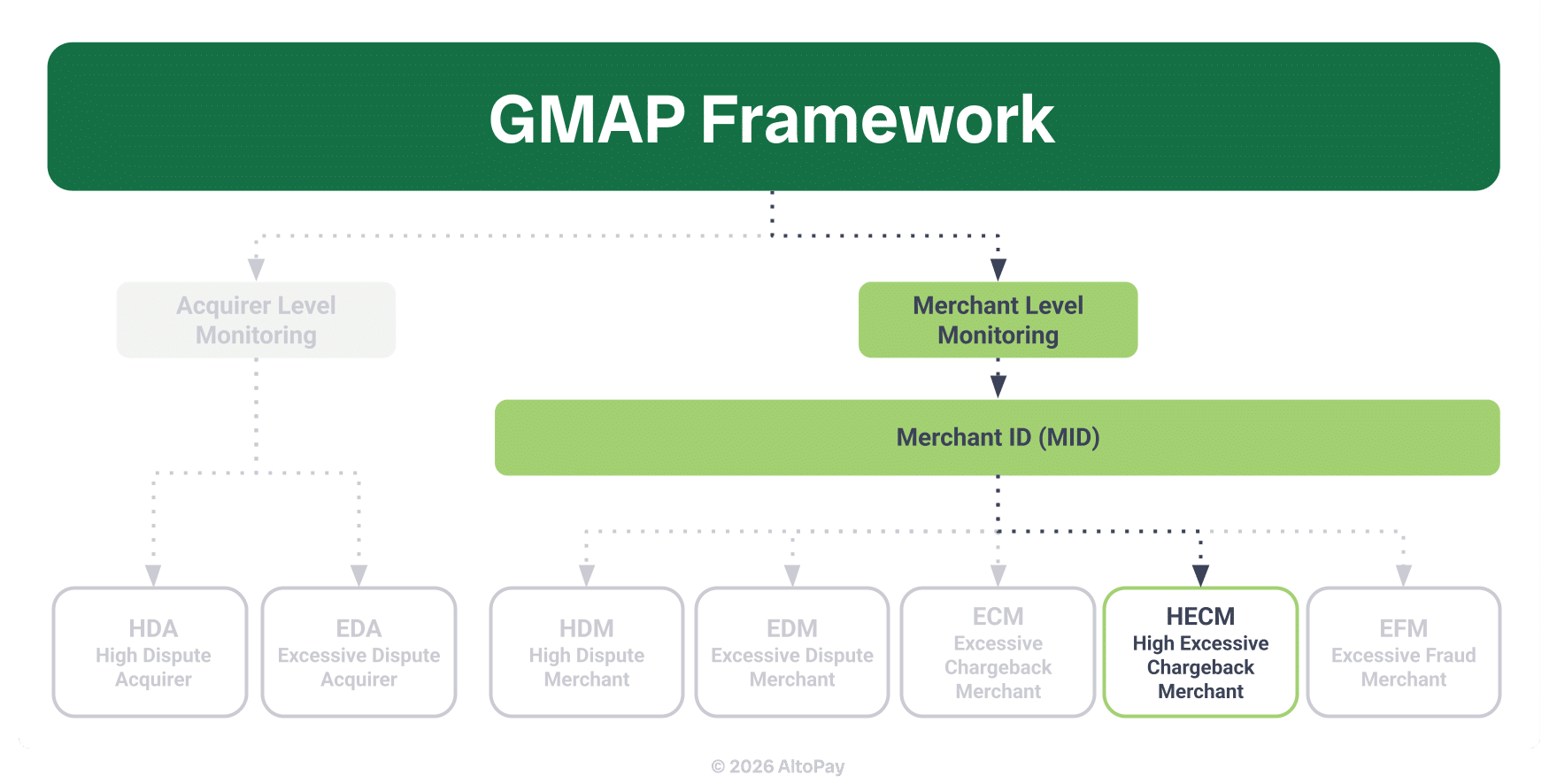
A merchant is classified as a High Excessive Chargeback Merchant (HECM) when chargeback levels are elevated for a sustained period of time.
These are the thresholds. Breaching all of these in a single month triggers an HECM audit.
- 25 or more transactions
- 300 or more chargebacks
- 3% or higher chargeback-to-transaction ratio (percent of chargebacks received in the current month compared to sales from the previous month)
Fees are assessed each month the merchant is in the program.
| MONTH | FEE |
|---|---|
| Month 1 | $0 USD monthly |
| Month 2 | $1,000 USD monthly |
| Month 3 | $2,000 USD monthly |
| Months 4 - 6 | $10,000 USD monthly |
| Months 7 - 11 | $50,000 USD monthly |
| Months 12 - 18 | $100,000 USD monthly |
| Months 19+ | $200,000 USD monthly |
If merchants have open HECM audits for four or more months, they may need to complete a monthly internal review at their expense and address any identified issues.
Excessive Fraud Merchant (EFM) thresholds and fines
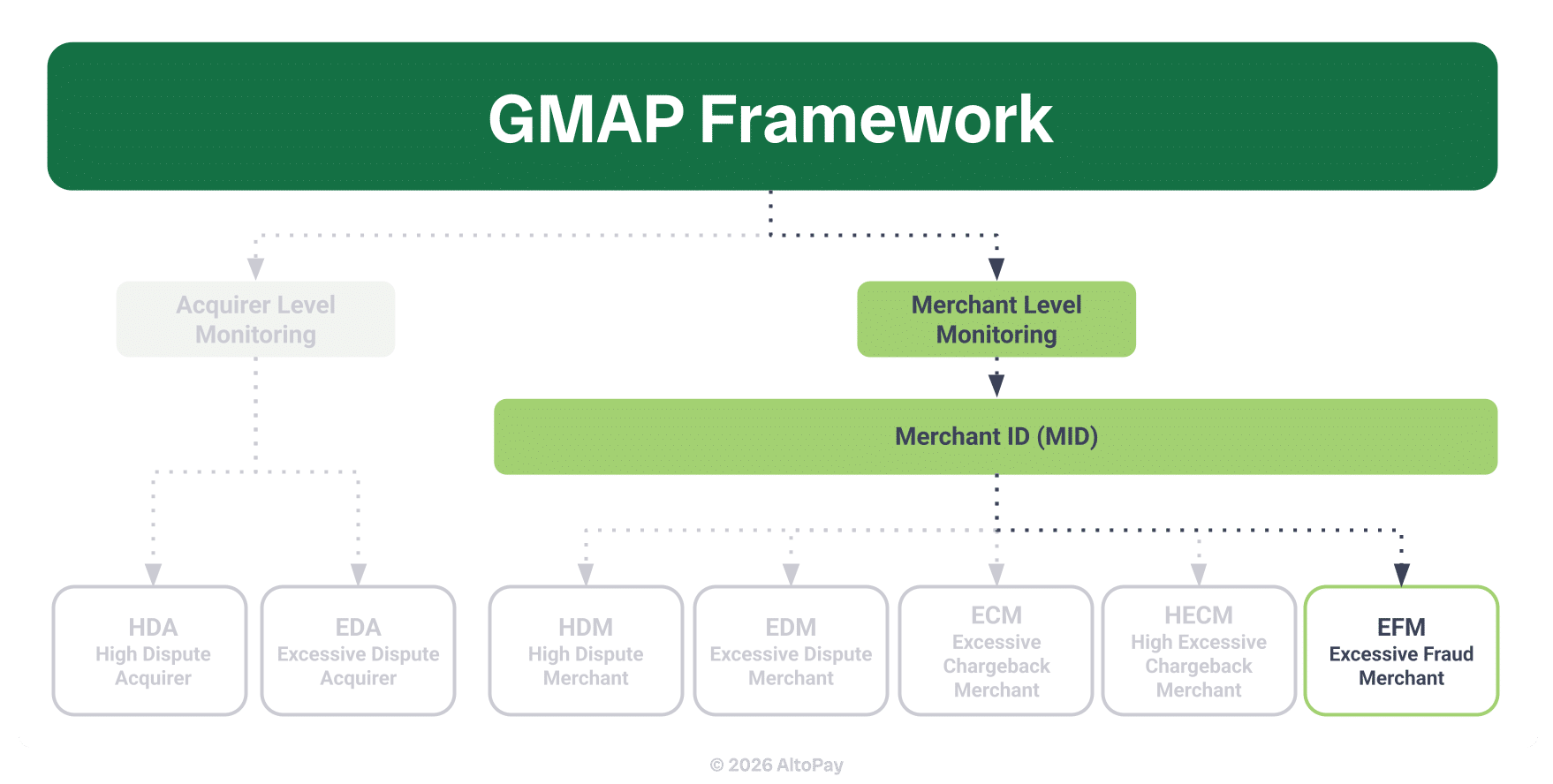
A merchant is classified as an Excessive Fraud Merchant (EFM) when fraud-related chargebacks start to escalate.
These are the thresholds. Breaching all of these in a single month triggers an EFM audit.
- 1,000 or more ecommerce transactions
- 50 or more fraud-coded chargebacks
- $50,000 USD or more in fraud-coded chargebacks
- 0.5% or higher chargeback-to-transaction ratio (percent of fraud chargebacks received in the current month compared to sales from the previous month)
Fees are assessed each month the merchant is in the program.
| MONTH | FEE |
|---|---|
| Month 1 | $0 USD monthly |
| Months 2 - 3 | $1,000 USD monthly |
| Months 4 - 6 | $5,000 USD monthly |
| Months 7 - 11 | $25,000 USD monthly |
| Months 12 - 18 | $50,000 USD monthly |
| Months 19+ | $100,000 USD monthly |
Special classifications for PayFacs and PayFac merchants
The GMAP announcement introduces a new monitoring strategy.
Traditionally, all of Mastercard’s merchant monitoring has happened at the MID level. However, GMAP introduces a new option: monitoring at the submerchant ID level.
This means PayFacs can monitor risk and assign liability on a submerchant level.
The hierarchy looks like this:
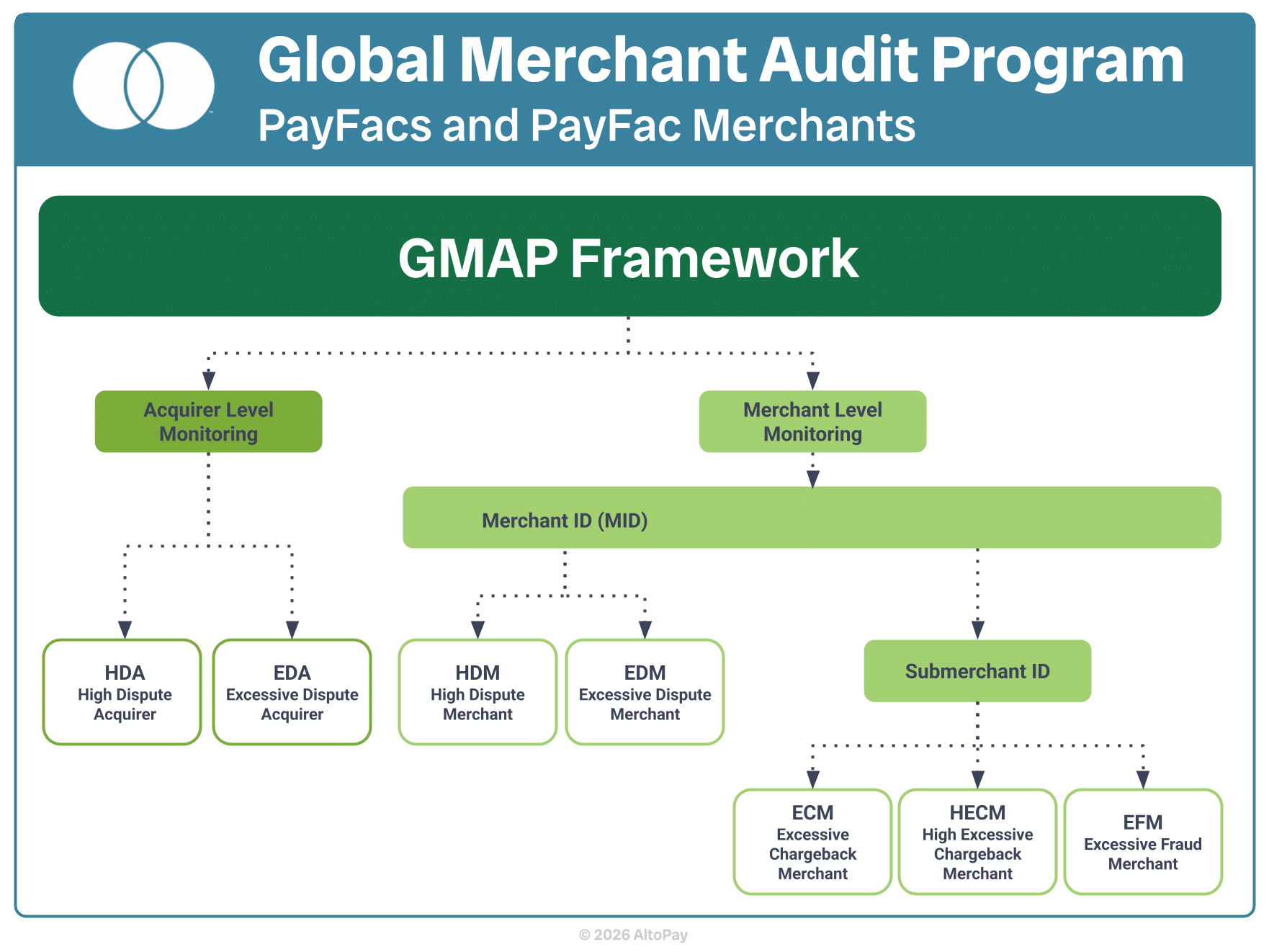
HDM and EDM remain MID-level subcategories. But ECM, HECM, and EFM can be monitored on the submerchant level.
Submerchant thresholds and fees
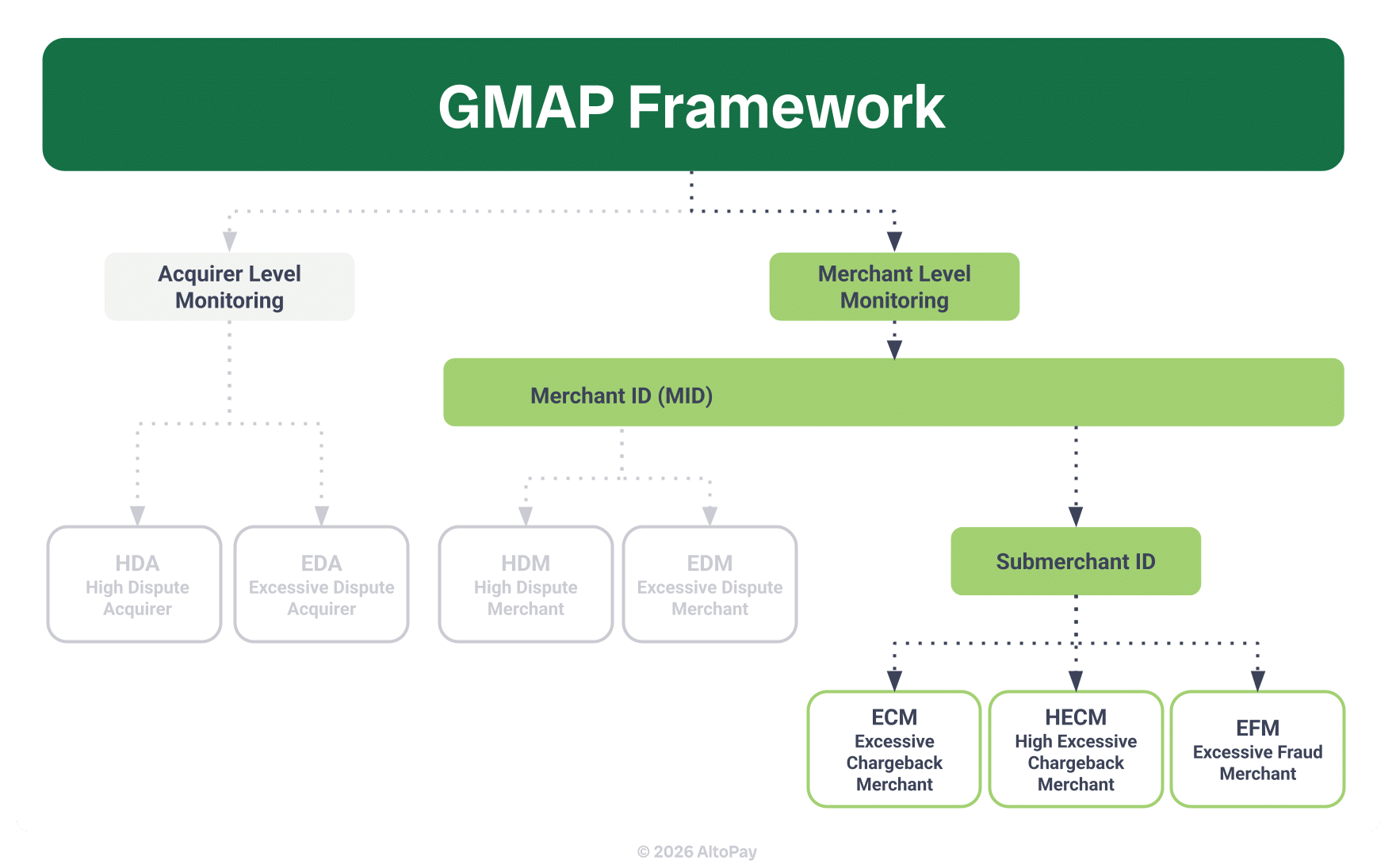
The thresholds for subcategories monitored at the submerchant level are the same and traditional MID-level monitoring. Check our previous section to learn more.
A hypothetical example of MID monitoring vs. submerchant monitoring
Acme, a popular PayFac, uses submerchant IDs to board individual merchants, but they all roll up under one MID. When the MID breach monitoring program thresholds, the PayFac is liable for corresponding penalties.
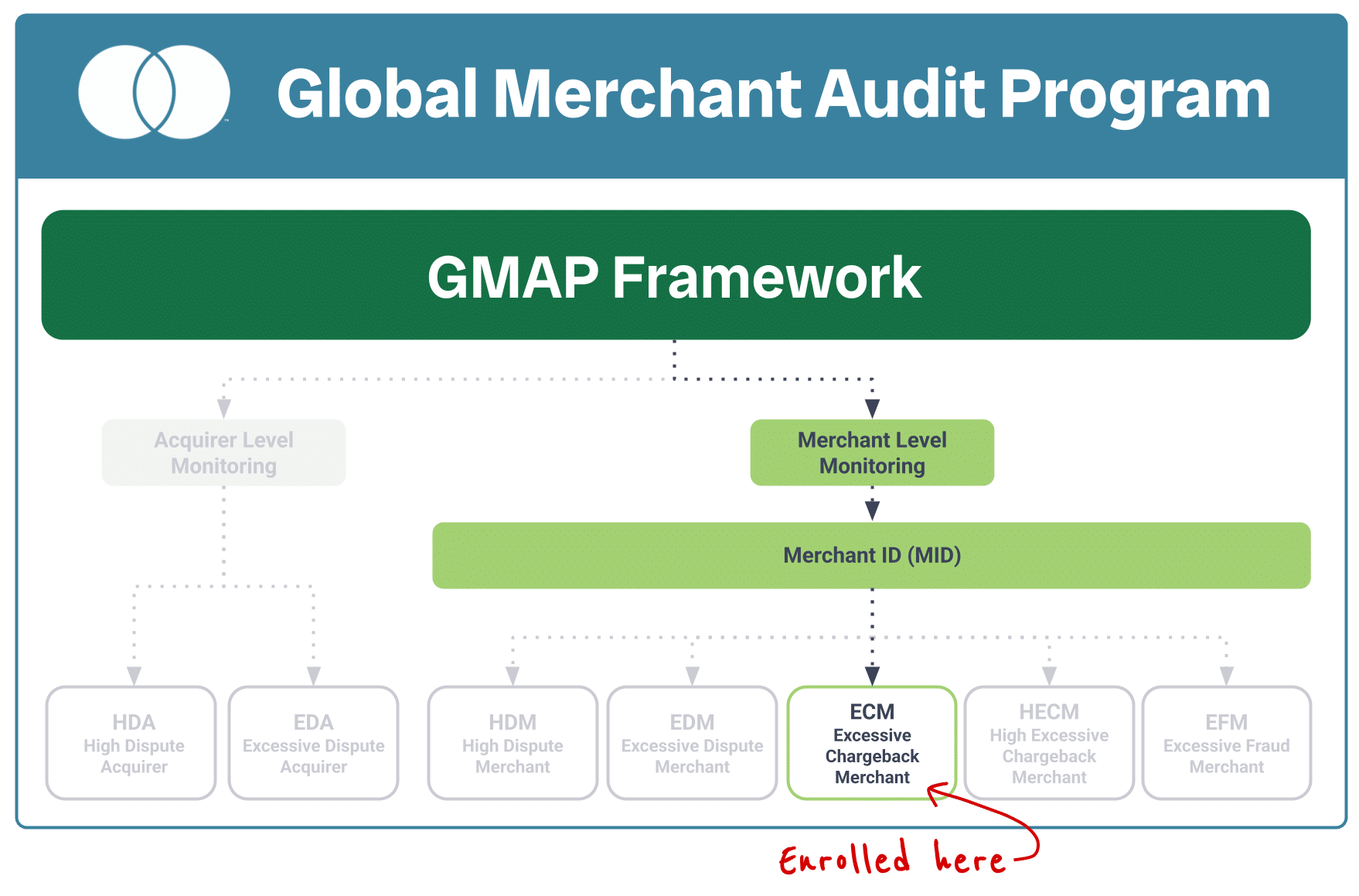
So when individual merchants — like Pete’s Pizza Parlor — experience an increase in chargeback activity, Acme will likely terminate Pete to save the health and stability of the overall MID.
But with the latest GMAP update, Acme’s risk management strategy could shift.
When Pete’s Pizza Parlor breaches thresholds, Acme has options. Termination is still possible; but instead, Acme could just fine Pete because Acme will now have the data needed to make that possible.
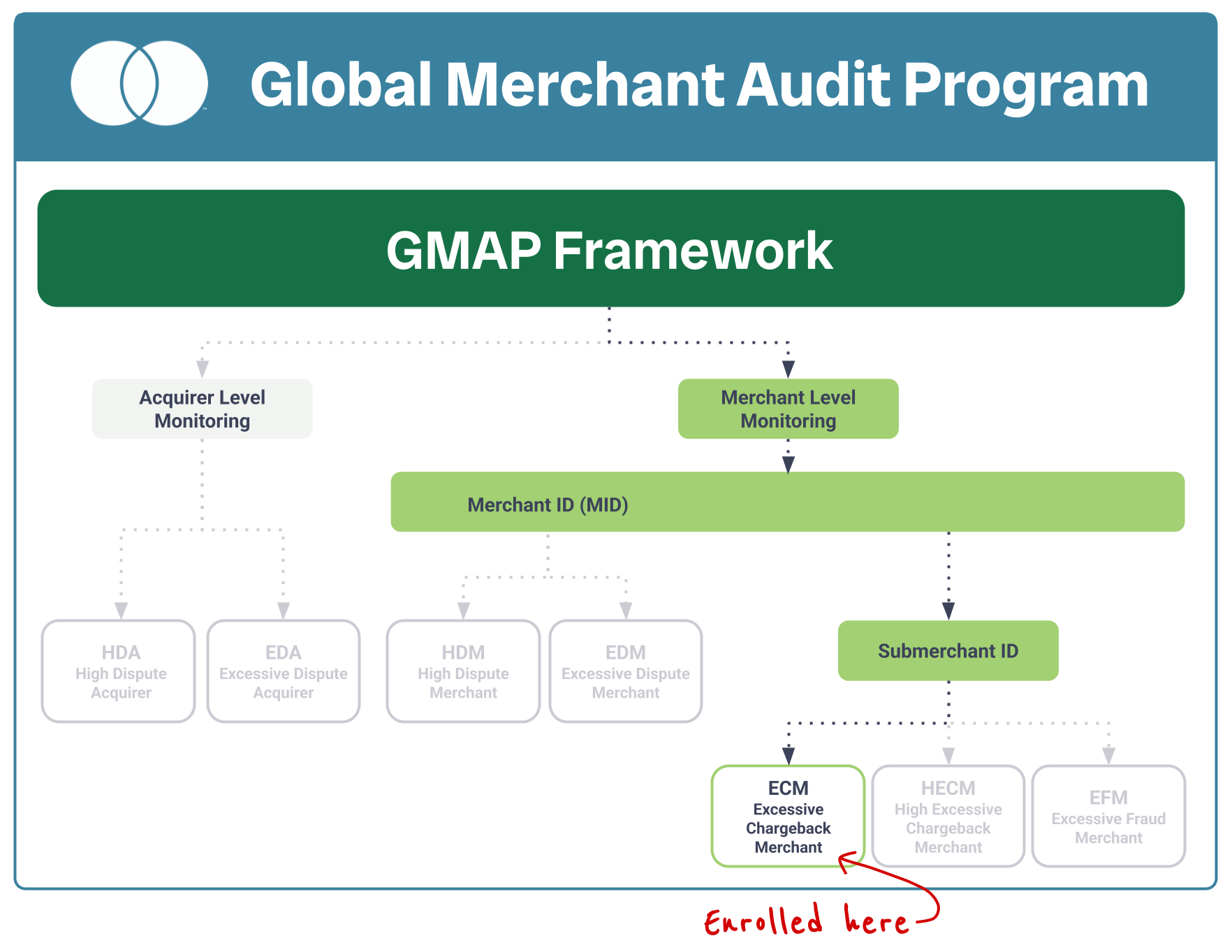
This could potentially revolutionise how PayFacs manage risk. However, as is the case with all brand updates, actual results won’t be realised until the standard takes effect.
What are the GMAP fees?
A GMAP audit could trigger fees. Applicable fees are charged to the acquirer who may pass them down to individual merchants — possibly with a markup in price.
As we saw with VAMP, acquirers can and will assess fees however they choose. So the impact on individual merchants will vary.
NOTE
The VAMP update assessed fees on a per-case basis — each fraud claim and chargeback triggered a fee. But with GMAP, fees are assessed in bulk for each month the merchant or acquirer is in the program.
These are the fees published in the GMAP announcement.
| HDA (Acquirer) | EDA (Acquirer) | HDM (Merchant) | EDM (Merchant) | ECM (Merchant) | HECM (Merchant) | EFM (Merchant) | |
|---|---|---|---|---|---|---|---|
| Month 1 | $0 | $0 | $0 | $5,000 | $0 | $0 | $0 |
| Month 2 | $0 | $0 | $0 | $25,000 | $1,000 | $1,000 | $1,000 |
| Month 3 | $0 | $10,000 | $0 | $100,000 | $1,000 | $2,000 | $1,000 |
| Months 4 - 6 | $0 | $10,000 | $0 | $100,000 | $5,000 | $10,000 | $5,000 |
| Months 7 - 11 | $0 | $25,000 | $5,000 | $100,000 | $25,000 | $50,000 | $25,000 |
| Months 12 - 18 | $25,000 | $50,000 | $10,000 | $200,000 | $50,000 | $100,000 | $50,000 |
| Months 19+ | $50,000 | $100,000 | $25,000 | $300,000 | $100,000 | $200,000 | $100,000 |
NOTE
Fees are assessed for each month the acquirer or merchant is in the program. The longer a member stays in the program, the more they’ll pay in fees.
Here are a couple of examples:
- If a merchant has an open ECM audit for 6 months, the merchant would pay a minimum of $17,000 in fees.
- If an acquirer has an open EDA audit for 11 months, the acquirer would pay a minimum of $165,000 in fees.
Unfortunately, it is possible for a merchant to be enrolled in multiple GMAP subcategories at once. For example, a single merchant might be audited for both HDM and ECM.
But fortunately, Mastercard will only assess fees on one subcategory — the subcategory with the highest of the potentially applicable fees.
Fee extensions
Sometimes, a good merchant finds themselves in a bad situation — meaning a GMAP audit is opened against a merchant who isn’t typically considered a risk.
In these situations, an acquirer can request an extension. A GMAP extension will pause fees for six months, allowing the merchant and acquirer time to fix the underlying issues that caused the influx in fraud and chargebacks.
There are a couple of caveats though.
- Extensions are only given once. If a merchant breaches thresholds again in the future, another extension won’t be granted.
- Fees are waived temporarily. If the merchant can achieve compliance for three consecutive months during the grace period, the fees will be permanently waived. However, if the merchant is still non-compliant when the extension ends, the fees will be applied retroactively. Fees will also be applied retroactively if the acquirer terminates the MID (or submerchant ID) during the grace period.
How does an acquirer or merchant exit GMAP?
Acquirers and merchants are enrolled in GMAP when all the applicable thresholds are breached in a given month. They will remain in the program until fraud and chargeback activity drops below the threshold and stays compliant for three consecutive months.
If thresholds are breached in the future, the acquirer or merchant will be enrolled again.
If a merchant is flagged for more than one subcategory — for example both HDM and ECM — then the merchant will need to become compliant with thresholds for both classifications before the audit is closed.
NOTE
Mastercard thresholds are a worst-case scenario. It is possible for acquirers to take action against a high-risk merchant before official thresholds have been breached.
If you are a merchant, we suggest you talk to your acquirer or PayFac about their preferences, expectations, fees, and penalties.
Start preparing for GMAP now
Mastercard’s latest update is significant and far-reaching. It is completely understandable if you have questions or concerns. Don’t hesitate to reach out to the AltoPay team if you’d like to chat about how to navigate the all-new GMAP.
AUTHOR
Jessica Velasco
For more than a decade, Jessica Velasco has been a thought leader in the payments industry. She aims to provide readers with valuable, easy-to-understand resources.