Collaboration is a litigation-based chargeback management workflow introduced by Visa during the 2018 VCR initiative. It is essentially a rebrand of the same workflow that Visa used for decades — which other card brands still use today.
With Visa Claims Resolution (VCR), Visa pivoted from one workflow to two: collaboration and allocation.
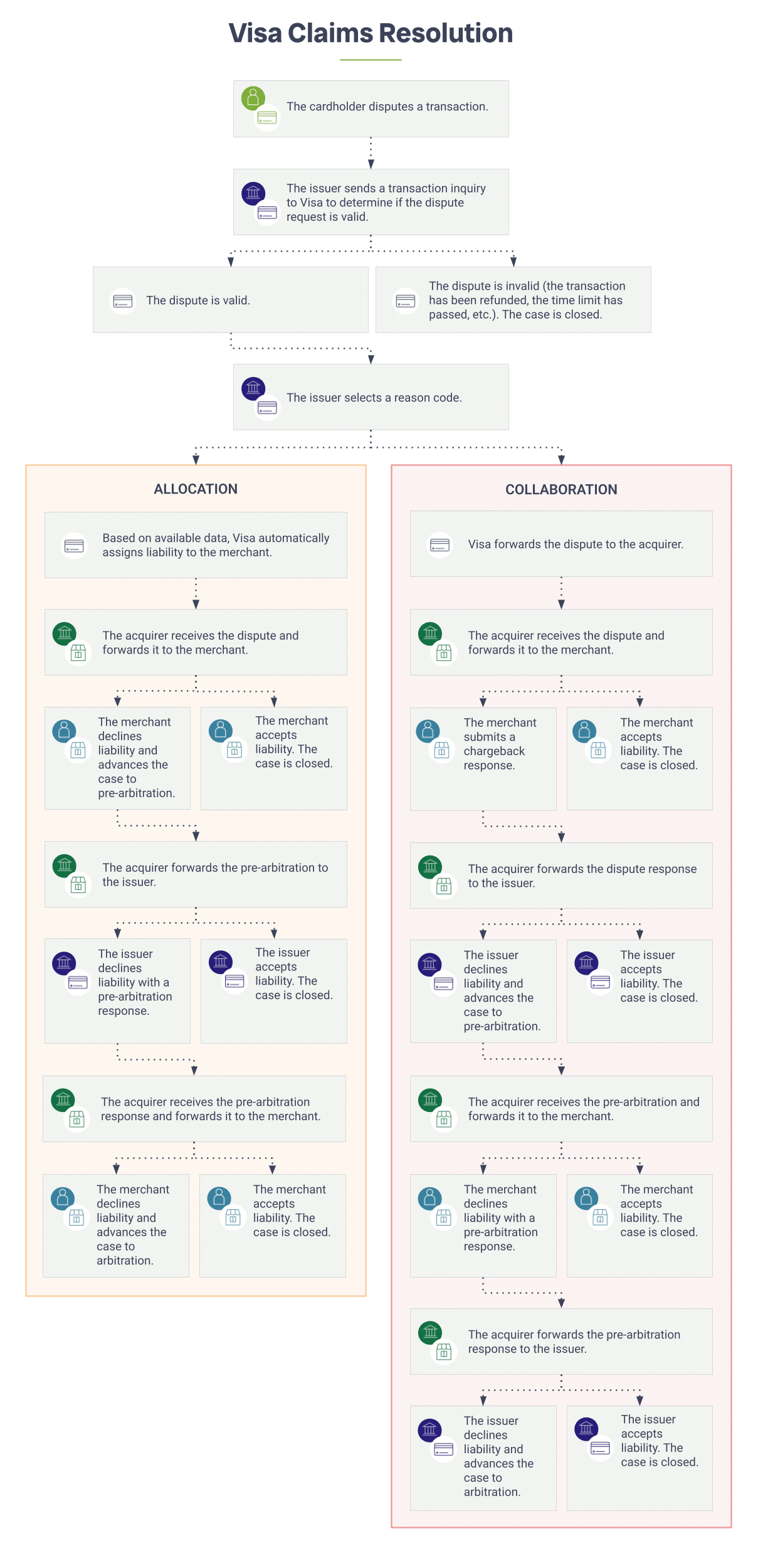
Collaboration allows the issuer and acquirer to both present their arguments before liability is assigned. On the other hand, allocation uses Visa’s internal data to automatically assign liability to either the issuer or acquirer.
Collaboration is used to manage chargebacks that fall into the processing error category (dispute reason codes that start with 12) and the consumer disputes category (dispute reason codes that start with 13).
It includes all five phases of the dispute resolution process:
- The issuer submits a chargeback to the acquirer.
- The acquirer passes the chargeback to the merchant. The merchant can challenge the validity of the dispute, if desired, with a chargeback response.
- The issuer can accept the liability shift from the acquirer or decline liability with a pre-arbitration attempt.
- The acquirer shares pre-arbitration with the merchant. The merchant can accept liability or decline liability with a pre-arbitration response.
- The issuer can choose to accept liability or advance the case to arbitration.
AltoPay aims to simplify the complexities of payments — including chargeback management. Regardless of which path a dispute takes — allocation or collaboration — we can help you manage it with our chargeback management solutions.
Allocation vs. Collaboration
Both Visa workflows give you, the merchant, the opportunity to challenge invalid disputes and recover revenue that has been unfairly sacrificed. However, the way you go about doing that differs.
Here is a high-level overview of the two different Visa chargeback workflows. Visit our VCR glossary entry to learn more.