



Understanding the chargeback process is critical for managing disputes efficiently and maximizing your ROI. In this detailed guide, we’ll walk you through the complete chargeback process — from dispute to resolution.
The Chargeback Process: A Real-Life Explanation
Chargebacks can be complex and difficult to understand. It’s easy to get confused by the terminology and technicalities of how the chargeback process works.
At AltoPay, our goal is to simplify complexities. So we’ve come up with an easy way to explain the chargeback process using a real-world example of how a dispute unfolds.
As you read through the story, there are opportunities to dive deeper into the specifics. Take a look at our detailed flow charts or simply continue through the narrative.
Meet the main characters
In any chargeback situation, there are always four main characters. And each character has a different role to play in the chargeback process.

The cardholder is the consumer who makes a purchase. In our story, Callie plays the role of the cardholder.

The issuer is the bank that manages the cardholder’s account. Isaiah represents the cardholder’s point of contact at the issuing bank.

The merchant is the business where the cardholder makes a purchase. Matt is the merchant character.

The acquirer is the bank that manages the merchant’s account. Alice plays the part of the merchant account manager at the acquiring bank.
The complete workflow is made up of five phases.
Let’s take a look at how a chargeback progresses from one stage to the next.
NOTE
Before we start the story, there are a couple important things to note.
First, a typical chargeback scenario is usually complete after one or two phases. Occasionally, a case advances through all five stages (this is extremely rare for American Express and Discover disputes).
In our example, the case progresses through the very last phase to give you a complete overview of the process.
Second, the chargeback process is different for Visa allocation disputes. Check our guide to learn more about Visa allocation.
PHASE #1
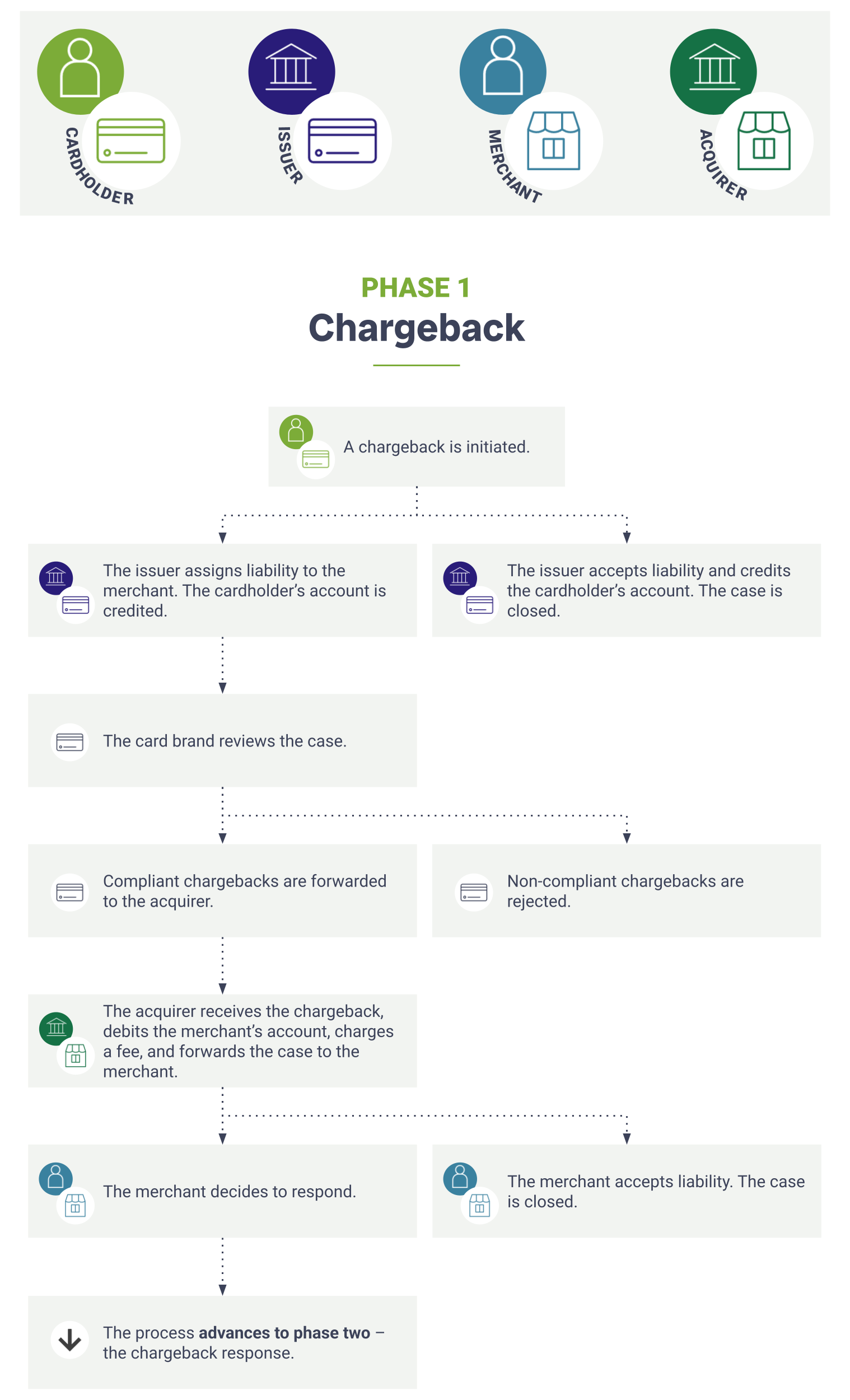
Chargeback
Callie — the consumer — is attending an awards ceremony for work and needs a new dress to wear. She orders a custom, hand-made dress from an online store called Matt’s Formal Wear.
Weeks later, the dress arrives. Callie is ecstatic to see what Matt created for her. But when Callie tries the dress on, she discovers it is too small. Callie had given Matt the wrong measurements!
Callie panics. She emails the customer service team at Matt’s Formal Wear and explains the situation. Matt is sympathetic but unable to do what Carli asks — he can’t make the dress larger nor can he offer a replacement since he wouldn’t be able to resell Callie’s custom dress.
Callie is upset. She is out a ton of money and still had to buy another dress. So Callie decides to file a chargeback.

Callie calls her bank — the issuer — and Isaiah answers the phone. Callie explains how she ordered a dress from Matt’s Formal Wear. But then she fibs a little. Callie says Matt sent the wrong size and now the company is refusing to give her a refund for the mixup.
Based on the information Callie provides, Isaiah decides the situation warrants a chargeback.
In the Mastercard online portal, Isaiah enters the necessary information to initiate the dispute. Once the chargeback is filed, Callie’s bank account is credited for the transaction amount.
Callie is ecstatic; she immediately goes out to find a new dress — the party is only a week away!
Meanwhile, Mastercard forwards the chargeback to Matt’s acquiring bank. Matt’s merchant account is debited for the amount that was returned to Callie plus a chargeback fee. The acquirer sends a notice to Matt, informing him of the chargeback.
When Matt receives the chargeback notice, he is shocked. He hadn’t done anything wrong! And now he has a chargeback?!
Matt has two options. He can accept the chargeback and lose his hard-earned money. Or he can fight back and recover the lost revenue.
Matt decides to fight the chargeback.
PHASE #2
Chargeback Response
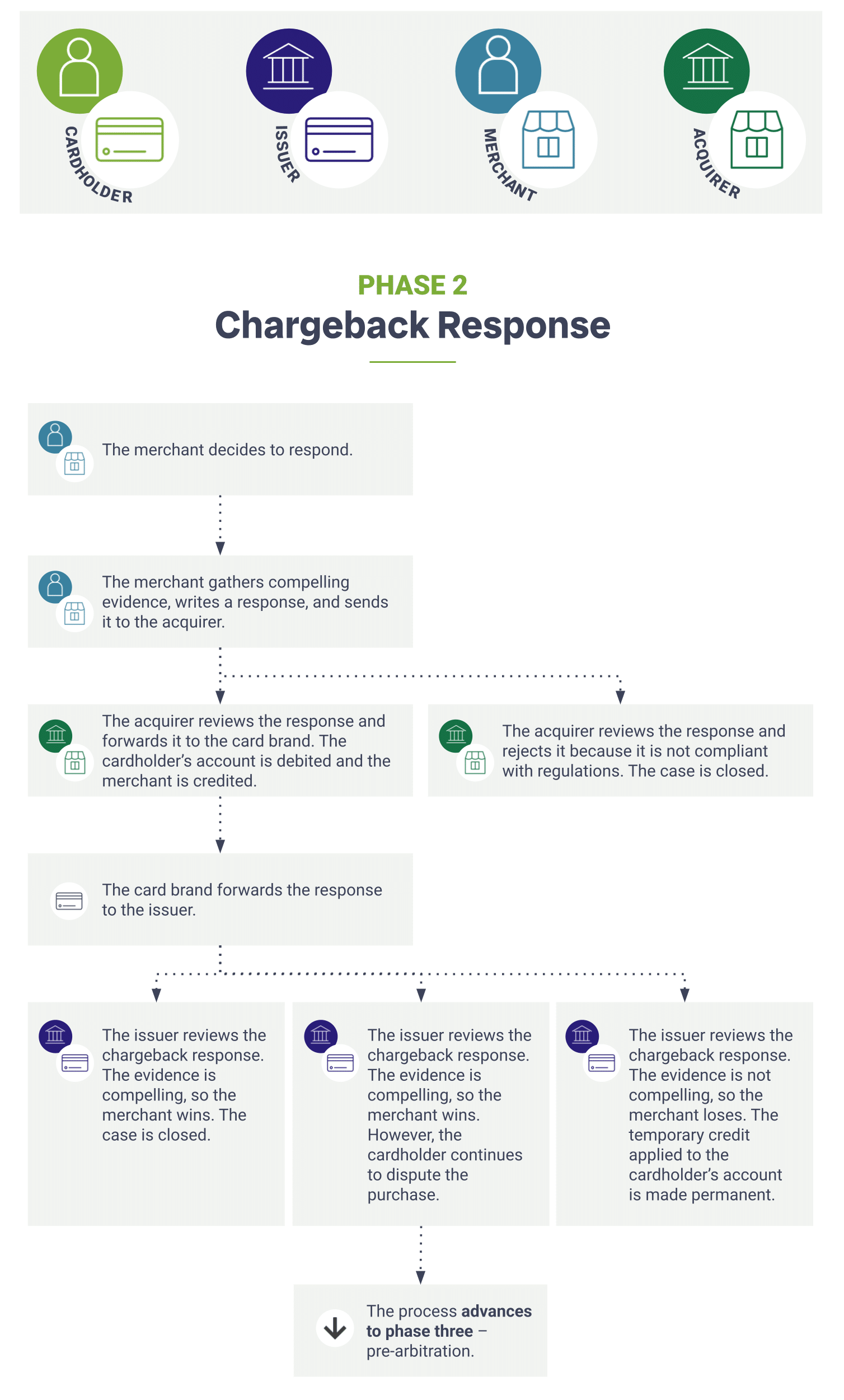
Matt collects all the information he has about Callie’s purchase — a description of the item she bought, the measurements she sent, the company’s refund policy, and email exchanges.
Matt writes a rebuttal letter to explain the situation and challenge Callie’s claims. He sends his letter and his supporting documents to his bank.

Alice, a representative at Matt’s acquiring bank, receives the chargeback response. Based on the information provided, it seems like a compelling argument. And, Matt adheres to the bank’s submission deadline. Since everything seems to be in order, Alice uploads the response to the Mastercard online portal. The dispute amount is returned to Matt’s merchant account.
Callie’s bank is notified that Matt has responded to the chargeback. Matt’s evidence is strong and contradicts Callie’s claim. Isaiah, at the bank, calls Callie to give her an update — her account will be debited a second time.
Callie freaks out. She has already spent the money she recouped on another dress! She can’t afford both! So Callie tries another tactic.
Callie claims that, since the original dispute, the situation has gotten worse. She has discovered the sewing on Matt’s dress is faulty — the seams have come undone. The size is irrelevant because the product is defective.
Callie demands that Isaiah dispute the charge a second time.
PHASE #3
Pre-Arbitration
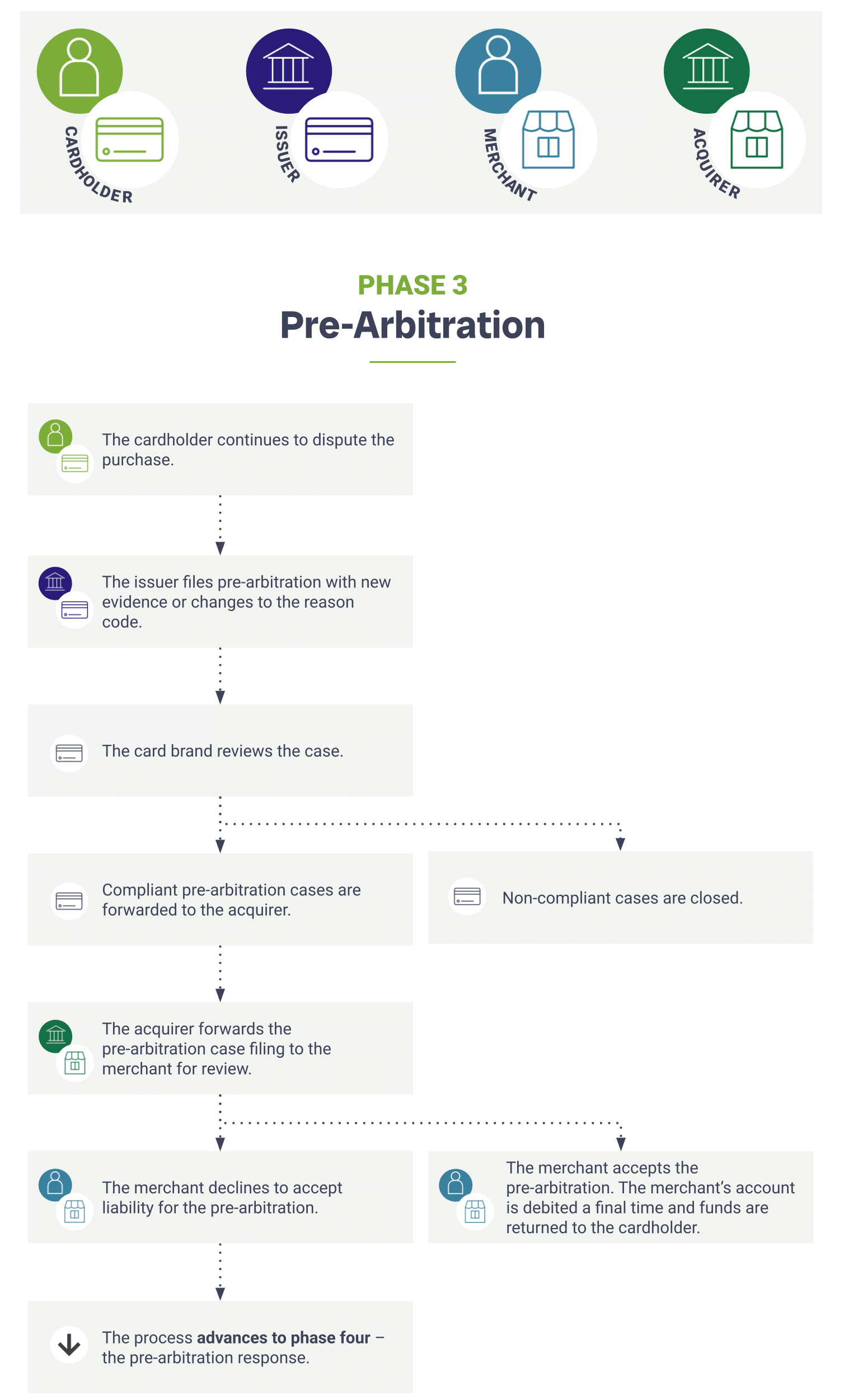
At Callie’s bank, Isaiah goes back to the Mastercard online portal and disputes the transaction again, noting Callie’s new reasoning.
The pre-arbitration notice is sent to Matt’s bank, and Alice forwards it on to Matt.

The notice explains that Matt has two options. He can accept responsibility and his merchant account would be debited once again. Or he could decline liability and keep challenging Callie’s claims.
A lot of money is at stake. But, if Matt continues to fight, he has the potential to lose even more. The longer the battle rages, the more he’ll pay in costs and fees.
Despite the risks, Matt decides to keep fighting. He isn’t ready to give up yet!
PHASE #4
Pre-Arbitration Response
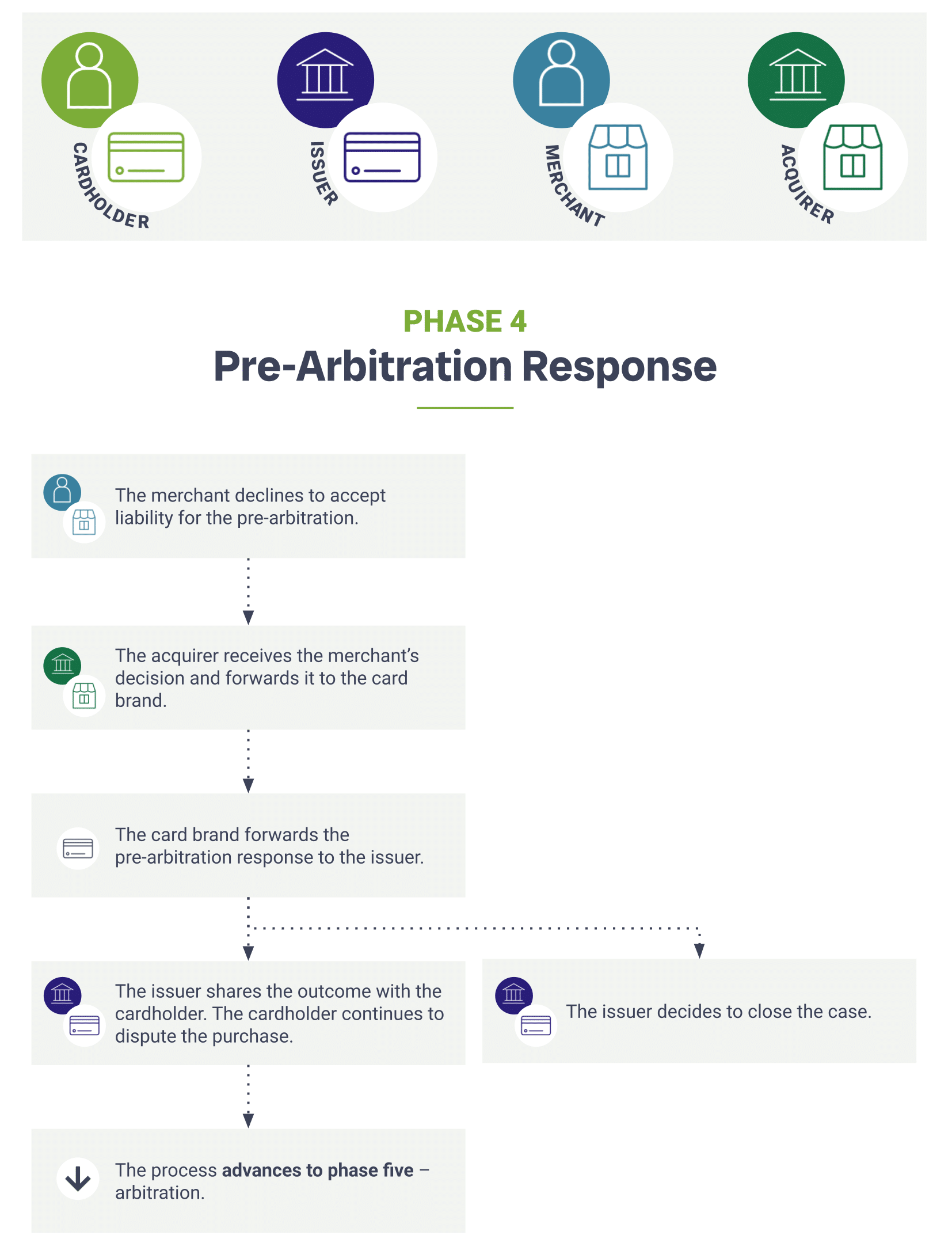
Matt tells Alice at the acquiring bank that he is not going to accept liability. Alice uses the Mastercard portal to inform Callie’s issuing bank of Matt’s decision.
Isaiah at the issuing bank receives the pre-arbitration response and calls Callie to update her on the situation — Matt has submitted a pre-arbitration response and will not accept liability. Callie is shocked — and nervous. She fully expected Matt to just give up. She really wanted that money back in her account!
Anxious about the current condition of her finances, Callie asks Isaiah what her options were. Isaiah explains that there is one last chance to recover the money. Carli can appeal to Mastercard for arbitration.

Arbitration would draw out the dispute process by several more months. But Callie is desperate. She decides to take the gamble.
Callie tells Isaiah that she wants to try the arbitration process.
PHASE #5
Arbitration
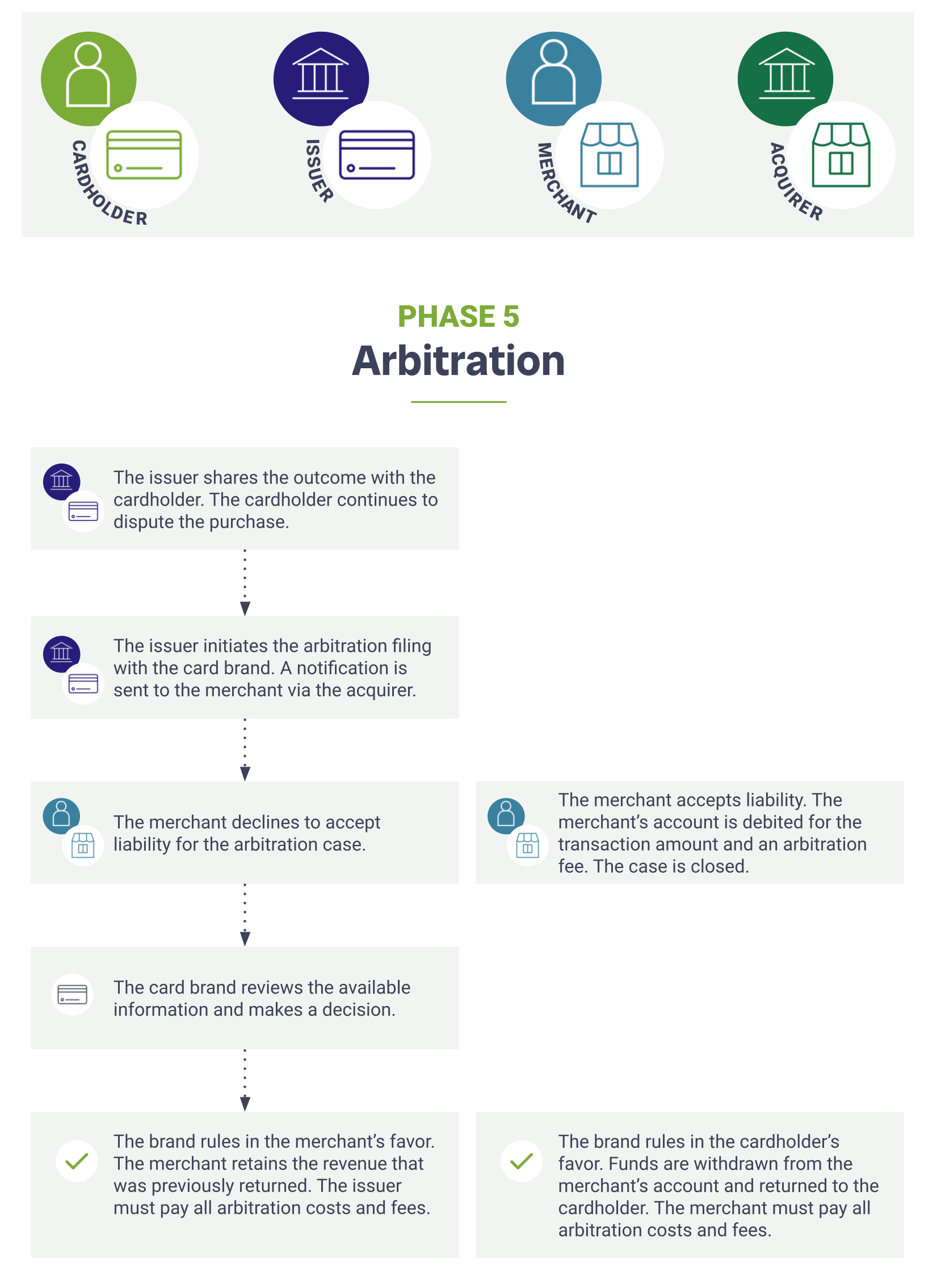
Isaiah at Callie’s bank initiates the arbitration process.
A representative at Mastercard reviews all the information related to the case. And a decision is made: Callie, not Matt, has made a mistake. She has committed friendly fraud — filing a chargeback for an invalid reason.
Matt has fulfilled his obligations and should be compensated. Callie needs to pay Matt for what is owed. Therefore, the temporary credit that was made to Matt’s account and the temporary debit to Callie’s account are made permanent.
The case is closed.
SUMMARY
5 key takeaways from the chargeback process
We hope this approach to explaining the chargeback process was helpful. Our goal was to make the workflow easy to understand.
However, the nonchalant storytelling might have led you to overlook a few points. Let’s review some important topics.

This overview is a general explanation.
The process we outlined here is not a universal explanation for all disputes. The card brands (Discover, Visa, Mastercard, American Express) have detailed rules that regulate the chargeback process — each version slightly different from another. And acquirers and processors often put their own unique spin on the workflow.
So while what we’ve explained is the general process that applies to most disputes, there are some situations that will differ from the norm. Visa’s allocation disputes being a perfect example.

The process is more difficult to manage when you have multiple disputes.
In this story, the merchant was dealing with just one chargeback. But in real life, you could receive several disputes in a single day. Which means that, at any given moment, you could be juggling multiple cases at different stages of the chargeback process.
Managing all that can turn into a costly, confusing, time-consuming headache.

Arbitration is a costly risk.
In this example, the card brand found in the merchant’s favor. However, that isn’t always the case in real life.
Our team usually advises merchants to accept liability if a chargeback advances to pre-arbitration.
NOTE
Visa allocation disputes are the exception to this rule. You can and should engage in pre-arbitration for allocation disputes.
You probably only want to risk arbitration if the transaction amount is very high and the available evidence is very compelling.

The chargeback process is just one small piece of the puzzle.
What we’ve explained here is the official process regulated by the card brands. But a comprehensive chargeback management strategy involves much more than just understanding how disputes work. You also have to understand…
- The process of detecting criminal fraud and blocking unauthorised transactions.
- The process of creating policies and procedures that ensure a positive customer experience.
- The process of analysing chargeback data to figure out why chargebacks are actually happening.
- The process of calculating ROI and optimising your strategy for financial success.

Professionals can help.
No one expects you to navigate the complexities of chargebacks on your own. You can and should get help!
If you’d like to learn more about how chargeback experts — like the team at AltoShield — can make the chargeback process more manageable, reach out today. We are happy to schedule a call and talk through your strategy.
AUTHOR
Jessica Velasco
For more than a decade, Jessica Velasco has been a thought leader in the payments industry. She aims to provide readers with valuable, easy-to-understand resources.