

Reason Code List / Mastercard / Reason Code 4837
DESCRIPTION
Why did I receive a chargeback with reason code 4837?
You received this chargeback because the cardholder claims the transaction was unauthorised.
This reason code can be used for both card-present and card-not-present transactions.
NOTE: Mastercard’s rules for this one single reason code are more than 70 pages long. We’re going to shorten and simplify the information, omitting details that are only applicable to issuers and acquirers. Our goal is to help merchants easily understand the details that are relevant to them.
Need help managing Mastercard 4837 chargebacks?
Let AltoShield help you create a comprehensive chargeback management strategy that can lower risk, reduce costs, boost approvals, and improve processing sustainability.
CLASSIFICATION
How does Mastercard classify this dispute?
Mastercard has four classifications for chargeback reason codes:
- Authorisation-related chargebacks
- Cardholder dispute chargebacks
- Point-of-interaction error chargebacks
- Fraud chargebacks
Reason code 4837 is a fraud-related chargeback.
Mastercard has two transaction processing workflows: dual message and single message.
Reason code 4837 is used for the dual message system. The single message equivalent is reason code 37. While the codes are different, the rules and processes are generally the same for both dual message and single message.
TRANSLATION
What language can the issuer use for a 4837 chargeback?
If the issuer and acquirer do not share a common language, all relevant non-English documents must be accompanied by an English version.
If the issuer and acquirer do share a common language, an English translation of the documents is not necessary for most regions (Brazil is an exception) during the chargeback and second presentment stage of the transaction lifecycle.
However, if the case advances to pre-arbitration, all non-English documents shared during the previous stages of the dispute lifecycle must be translated. Any pre-arbitration and pre-arbitration response documents must also be translated.
If a translation is required but not provided, Mastercard will likely rule against the non-compliant party.
ISSUER TIME LIMIT
How long can the issuer wait to file a chargeback with reason code 4837?
In most regions and situations, the issuer must file a 4837 chargeback within 120 days of the transaction processing date.
SECOND PRESENTMENT
Can I fight a chargeback with reason code 4837?
Yes. You can respond to a chargeback with reason code 4837 — a process called representment or second presentment — in the following situations.
- The Address Verification Service (AVS) response was X or Y, and the merchandise was shipped to the AVS-confirmed address.
- You have compelling evidence that is specific to your industry or sales method.
- A refund was previously issued.
There are a couple of additional response options available because of specific industry or transaction characteristics.
- The same account that had one or more disputed funding transactions received — but did not dispute — one or more credits.
- The transaction was a no-show hotel transaction
- The addendum transaction is the cardholder’s responsibility.
- Compelling evidence is available for an airline, recurring, ecommerce, or MOTO transaction.
You can also respond if you think the chargeback is invalid. Here are some reasons why a 4837 might be invalid.
- You can provide evidence that the transaction resulted from an account takeover.
- The issuer has filed too many (36 or more) fraud-related chargebacks for this cardholder.
- The issuer approved a transaction after filing two or more fraud-related chargebacks for the same primary account number (PAN) and expiration date.
- The issuer didn’t report the criminal activity to Mastercard’s Fraud and Loss Database.
- A contactless transaction was processed at an unattended terminal.
- The cardholder authenticated the transaction with a PIN.
- The chargeback does not meet Mastercard’s filing requirements.
- The chargeback was processed after the time limit.
- Multiple chargebacks were filed for a single transaction.
- The primary account number (PAN) and acquirer reference data (ARD) listed in the chargeback do not match the data in the original transaction.
- The cardholder’s supporting documentation was not received.
- The cardholder’s supporting documentation was illegible, incomplete, or for a different chargeback.
- The chargeback’s message text was invalid.
PROOF
What compelling evidence or supporting documents are needed for chargeback reason code 4837?
Occasionally, issuers will inaccurately file 4837 chargebacks. If this happens and the chargeback can be challenged, your acquirer’s technology may catch the error and automatically respond on your behalf.
If your acquirer doesn’t automatically respond and you receive a chargeback notice, you can challenge the chargeback yourself. Here’s how.
Create a rebuttal letter and explain why the chargeback should be reversed. Include information that supports your case and is relevant to the reason for fighting the chargeback. If you want to be extra helpful, you could also provide the acquirer with Mastercard’s required message code.
- If you are disputing a chargeback because the transaction was the result of an account takeover, provide documentation to support your claim. For example, the daily loss data file, the monthly acquirer loss data file, the acquirer reported fraud dashboard in Mastercard Connect, or a statement from the cardholder confirming the account was taken over. The message code is 2713 (invalid chargeback).
- If you are disputing a chargeback because the issuer exceeded the chargeback count threshold, explain how many chargebacks you received (must be 36 or more) with the following reason codes: 4837, 4870, or 4871. The message code is 2713 (invalid chargeback).
- If you are disputing a chargeback because the issuer approved a transaction after filing two or more fraud-related chargebacks (reason codes 4837, 4870, or 4871) on the same PAN, provide the reason code and processing date for the previous chargebacks and the authorisation date for the current dispute. The message code is 2713 (invalid chargeback).
- If you are disputing a chargeback because the issuer didn’t report the transaction to the Fraud and Loss Database within three days of the chargeback, provide documentation to support your claim. For example, the daily acquirer loss data file, the monthly acquirer loss data file, or the acquirer reported fraud dashboard in Mastercard Connect. The message code is 2713 (invalid chargeback).
- If you are disputing a chargeback because the transaction was a contactless transaction at or below the acceptable CVM (cardholder verification method) limit, provide the transaction date and the authorisation approval code. You can include the message code for an invalid chargeback (2713) or you can use 2008 (issuer authorised transaction).
- If you are disputing a chargeback because the cardholder used a PIN for the transaction, provide the transaction date and the authorisation approval code. You can include the message code for an invalid chargeback (2713) or you can use 2008 (issuer authorised transaction).
- If you are disputing a chargeback because the issuer didn’t follow Mastercard’s rules, explain why the chargeback was invalid in your rebuttal letter. The message code is 2713 (invalid chargeback).
- If you are disputing a chargeback because it was filed after the time limit, share the transaction processing date and the chargeback processing date. The message code is 2702 (past chargeback time limit).
- If you are disputing a chargeback because the issuer had previously filed a chargeback for the same transaction, provide the processing date and the reference number for the first chargeback. The message code is 2701 (duplicate chargeback).
- If you are disputing a chargeback because the cardholder didn’t provide supporting documents within 10 days of the chargeback, you can simply reply with the message code: 2002 (non-receipt of required documentation to support chargeback).
- If you are disputing a chargeback because the cardholder’s supporting documents are illegible or incomplete, you can simply reply with the relevant message code: 2709 (documentation received was illegible) or 2710 (scanning error – unrelated documents or partial scan).
- If you are disputing a chargeback because the required message text wasn’t included in the notification, you can simply reply with the relevant message code: 2704 (invalid message text).
The majority of the time, your acquirer probably won’t catch the issue and you’ll be responsible for challenging the chargeback yourself. Be sure to provide the required supporting documents or compelling evidence.
If you are disputing the chargeback because the transaction was authenticated with AVS, provide documentation with the AVS response code (X or Y) and proof that the merchandise was sent to the AVS-confirmed billing address.
If you are disputing a chargeback because a refund has already been issued to the cardholder’s Mastercard account, provide the date and acquirer reference data (ARD) for the refund. The message code is 2011 (Credit Previously Issued).
If you are disputing the chargeback because the addendum charge was warranted, provide documentation that proves the cardholder participated in the original transaction and is responsible for the subsequent addendum transaction.
If you are disputing a chargeback for a non-face-to-face airline transaction, you must provide at least one of the following.
- A ticket or boarding pass showing the passenger’s name.
- A flight manifest or itinerary showing the passenger’s name.
- Proof of any additional transactions that are connected to the disputed transaction — such as upgrades, excess baggage charges, in-flight purchases, etc.
- Passenger identification documentation, credits, or frequent flyer miles that establish a link to the cardholder.
- Proof that the ticket or boarding pass was received — such as a signed delivery, copy of email sent to the cardholder’s email address, etc.
If you are disputing a chargeback for an ecommerce, mail order, or telephone order transaction, you must provide at least one of the following:
- A receipt, work order, or other document signed by the cardholder stating that the goods or services were received.
- The cardholder’s written agreement to receive electronic delivery of goods or services.
- A written conversation between the merchant and the cardholder proving the cardholder participated in the transaction. For example, emails, texts, chat messages, etc.
- Documentation showing the physical location where the cardholder picked up merchandise that was ordered online.
If you received authorisation for a related transaction (for a partial shipment or the payment of a balance due) after the initial authorisation, provide the following for the initial transaction: a description of the goods or services purchased, authorisation date, authorisation approval code, and proof the initial transaction was not disputed.
NOTE: Additional response options are available for domestic MOTO transactions in France, Ireland, and Turkey.
If you require cardholders to register prior to completing a purchase and you later dispute a chargeback, you’ll need to provide proof that the cardholder or an authorised user was registered with an authentication method (password, fingerprint, facial recognition, etc.). You’ll also need to provide one or more of the following:
- Proof the cardholder (or authorised user) completed other undisputed purchases before or after the alleged fraud.
- Proof the cardholder (or authorised user) completed the disputed transaction from a registered device and IP address.
- Details of the purchase.
- Signed proof of delivery.
- The email address used for digital download or wallet delivery.
- Proof the cardholder (or authorised user) registered the goods or services. For example, the cardholder registered for a warranty or future software updates.
- Proof the disputed goods or services were used.
- Proof an Identity Check transaction was used to register the account number for future transactions.
You can’t use this representment right if cardholders are allowed to checkout as a guest.
If you are disputing a chargeback for a non-face-to-face recurring or installment-based transaction, you must provide at all of the following.
- A description of the goods or services being provided.
- The start date of the recurring payment or installment-based repayment arrangement, the original transaction authorisation date, and authorisation approval code.
- Proof that the card validation code (CVC2) successfully matched for the original transaction and all other transactions had response code M.
- Proof the transaction was properly identified as a recurring payment or installment-based repayment. Or, documentation showing the cardholder knew about the recurring payment plan — such as proof the cardholder had to click-to-accept the terms or the cardholder signed a contract agreeing to the terms.
If you are disputing a chargeback because the cardholder claims a funding transaction for gaming was fraudulent, provide documentation that proves one or more subsequent credits (gaming payment transactions) were not disputed.
If you are disputing a chargeback for a no-show hotel transaction, explain that your no-show policy is compliant with Mastercard’s transaction processing rules. Also, share the last four digits of the primary account number (PAN), the cardholder’s name, and the reservation confirmation or folio number.
NOTE: Regardless of your reason for fighting the chargeback, make sure your documentation is compliant with Mastercard rules. Do not include the cardholder’s full account number (PAN) or any images that contain sexual subject matter.
ACQUIRER TIME LIMIT
How quickly do I need to file a chargeback response?
Response timelines vary by subcategory and region. Generally — in most regions and for most subcategories — responses must be submitted to the issuer within 45 days of the chargeback processing date.
There are a few timeline exceptions. The following countries have alternate time limits in certain situations — either 10, 20, or 30 days instead of 45.
- Costa Rica
- Kazakhstan
- Mainland China
- Nigeria
- Poland
- Tanzania
NOTE: This time limit is for the acquirer — not you, the merchant. Merchant time limits are usually much shorter. Review your chargeback notice or check with your acquirer to find out how long you have to respond.
ADVANCING THE CASE
Are pre-arbitration and arbitration an option for reason code 4837?
Yes, pre-arbitration and arbitration are an option for Mastercard reason code 4837.
An issuer can file pre-arbitration if the original chargeback was valid and at least one of the following is true:
- The addendum transaction is not the cardholder’s responsibility.
- The AVS response was not X or Y, and the goods were not shipped to the AVS-confirmed address.
- The transaction was not authenticated.
- The issuer provided compelling evidence and it wasn’t addressed by the merchant.
- A refund was not previously issued.
- The transaction was not a no-show hotel transaction.
- Your second presentment didn’t resolve the dispute.
If the issuer escalates the case to pre-arbitration, you — the merchant — have the chance to respond. You can either accept or reject liability. If you reject the pre-arbitration case, the issuer will likely proceed to arbitration. If that happens, you could be responsible for paying the expensive filing fees.
Here is an overview of the full Mastercard dispute lifecycle and which entity is responsible for each filing.
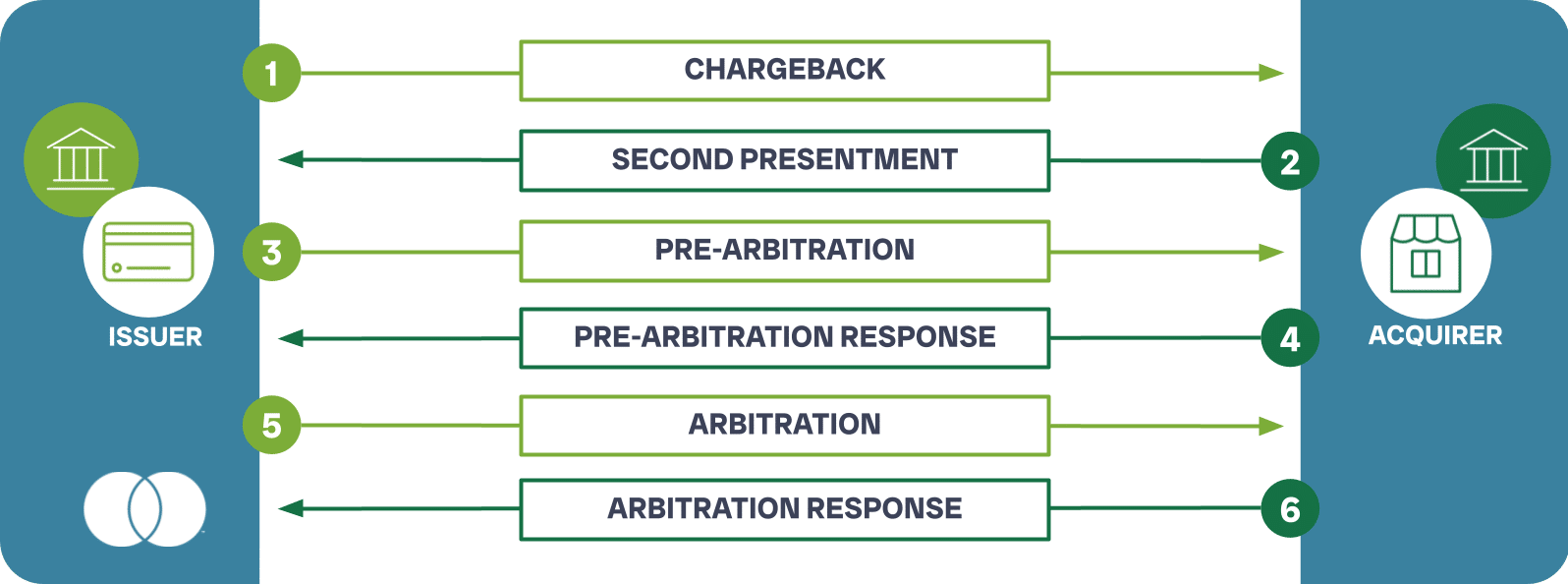
Check our Mastercard pre-arbitration and arbitration guide to learn more.
Changing the chargeback reason code
In certain situations, an issuer can change a chargeback’s reason code during the pre-arbitration process.
In order to change the reason for a dispute to 4837, all of the following conditions must be met:
- The original chargeback was valid.
- A second presentment remedied the original chargeback, but the issuer identified that a 4837 chargeback is applicable.
- The cardholder reviewed the second presentment supporting documentation and asserts the disputed transaction is fraudulent.
PREVENT
How can I avoid chargebacks like this in the future?
Here are steps you can take to avoid Mastercard reason code 4837 in the future.
- Consider using all the identity verification tools available to you — including Mastercard SecureCode, CVC2, and Address Verification Service (AVS).
- Use a third-party fraud detection solution that can help verify the cardholder’s identity, detect potential criminal activity, and reduce the risk of accepting unauthorised transactions.
- Use a billing descriptor that is easily recognized by the cardholder so legitimate purchases aren’t confused for fraud.
- Always submit an authorisation request, no matter the transaction amount.
- Follow up after a purchase has been made to gauge satisfaction and resolve any issues.
- Establish user-friendly policies to prevent friendly fraud masquerading as actual fraud.
- Clearly and concisely communicate your terms and conditions for recurring transactions.
- Ask cardholders to review and agree to the terms before completing the transaction.
- Explain when and how much you’ll charge the cardholder’s card for recurring and installment billing payment plans.
- Remind customers of upcoming charges, especially if a significant amount of time passes between each recurring or installment billing cycle.
- Make sure qualified cancellation and non-renewal requests are fulfilled promptly and accurately.
- Send a notification after you’ve cancelled a recurring payment plan.
- Check the customer’s ID for buy-online-pickup-in-store purchases.
- Consider using a blacklist or negative list to block customers who have previously filed a fraud-related chargeback.
Want more information about preventing fraud-related chargebacks? Visit our detailed guide on preventing chargebacks.
NOTE
Mastercard chargeback rules are complex. The guide is over 1,500 pages long — compared to 67 pages for Visa — and contains detailed rules for both issuers and acquirers.
In an attempt to simplify the complex, we are only sharing information that is most relevant to merchants. If you are an acquirer and in need of more details, reach out to our team. We’d be happy to walk through the specifics with you.
DESCRIPTION
Why did I receive a chargeback with reason code 4837?
You received this chargeback because the cardholder claims the transaction was unauthorised.
This reason code can be used for both card-present and card-not-present transactions.
NOTE: Mastercard’s rules for this one single reason code are more than 70 pages long. We’re going to shorten and simplify the information, omitting details that are only applicable to issuers and acquirers. Our goal is to help merchants easily understand the details that are relevant to them.
Need help managing Mastercard 4837 chargebacks?
Let AltoShield help you create a comprehensive chargeback management strategy that can lower risk, reduce costs, boost approvals, and improve processing sustainability.
CLASSIFICATION
How does Mastercard classify this dispute?
Mastercard has four classifications for chargeback reason codes:
- Authorisation-related chargebacks
- Cardholder dispute chargebacks
- Point-of-interaction error chargebacks
- Fraud chargebacks
Reason code 4837 is a fraud-related chargeback.
Mastercard has two transaction processing workflows: dual message and single message.
Reason code 4837 is used for the dual message system. The single message equivalent is reason code 37. While the codes are different, the rules and processes are generally the same for both dual message and single message.
TRANSLATION
What language can the issuer use for a 4837 chargeback?
If the issuer and acquirer do not share a common language, all relevant non-English documents must be accompanied by an English version.
If the issuer and acquirer do share a common language, an English translation of the documents is not necessary for most regions (Brazil is an exception) during the chargeback and second presentment stage of the transaction lifecycle.
However, if the case advances to pre-arbitration, all non-English documents shared during the previous stages of the dispute lifecycle must be translated. Any pre-arbitration and pre-arbitration response documents must also be translated.
If a translation is required but not provided, Mastercard will likely rule against the non-compliant party.
ISSUER TIME LIMIT
How long can the issuer wait to file a chargeback with reason code 4837?
In most regions and situations, the issuer must file a 4837 chargeback within 120 days of the transaction processing date.
SECOND PRESENTMENT
Can I fight a chargeback with reason code 4837?
Yes. You can respond to a chargeback with reason code 4837 — a process called representment or second presentment — in the following situations.
- The Address Verification Service (AVS) response was X or Y, and the merchandise was shipped to the AVS-confirmed address.
- You have compelling evidence that is specific to your industry or sales method.
- A refund was previously issued.
There are a couple of additional response options available because of specific industry or transaction characteristics.
- The same account that had one or more disputed funding transactions received — but did not dispute — one or more credits.
- The transaction was a no-show hotel transaction
- The addendum transaction is the cardholder’s responsibility.
- Compelling evidence is available for an airline, recurring, ecommerce, or MOTO transaction.
You can also respond if you think the chargeback is invalid. Here are some reasons why a 4837 might be invalid.
- You can provide evidence that the transaction resulted from an account takeover.
- The issuer has filed too many (36 or more) fraud-related chargebacks for this cardholder.
- The issuer approved a transaction after filing two or more fraud-related chargebacks for the same primary account number (PAN) and expiration date.
- The issuer didn’t report the criminal activity to Mastercard’s Fraud and Loss Database.
- A contactless transaction was processed at an unattended terminal.
- The cardholder authenticated the transaction with a PIN.
- The chargeback does not meet Mastercard’s filing requirements.
- The chargeback was processed after the time limit.
- Multiple chargebacks were filed for a single transaction.
- The primary account number (PAN) and acquirer reference data (ARD) listed in the chargeback do not match the data in the original transaction.
- The cardholder’s supporting documentation was not received.
- The cardholder’s supporting documentation was illegible, incomplete, or for a different chargeback.
- The chargeback’s message text was invalid.
PROOF
What compelling evidence or supporting documents are needed for chargeback reason code 4837?
Occasionally, issuers will inaccurately file 4837 chargebacks. If this happens and the chargeback can be challenged, your acquirer’s technology may catch the error and automatically respond on your behalf.
If your acquirer doesn’t automatically respond and you receive a chargeback notice, you can challenge the chargeback yourself. Here’s how.
Create a rebuttal letter and explain why the chargeback should be reversed. Include information that supports your case and is relevant to the reason for fighting the chargeback. If you want to be extra helpful, you could also provide the acquirer with Mastercard’s required message code.
- If you are disputing a chargeback because the transaction was the result of an account takeover, provide documentation to support your claim. For example, the daily loss data file, the monthly acquirer loss data file, the acquirer reported fraud dashboard in Mastercard Connect, or a statement from the cardholder confirming the account was taken over. The message code is 2713 (invalid chargeback).
- If you are disputing a chargeback because the issuer exceeded the chargeback count threshold, explain how many chargebacks you received (must be 36 or more) with the following reason codes: 4837, 4870, or 4871. The message code is 2713 (invalid chargeback).
- If you are disputing a chargeback because the issuer approved a transaction after filing two or more fraud-related chargebacks (reason codes 4837, 4870, or 4871) on the same PAN, provide the reason code and processing date for the previous chargebacks and the authorisation date for the current dispute. The message code is 2713 (invalid chargeback).
- If you are disputing a chargeback because the issuer didn’t report the transaction to the Fraud and Loss Database within three days of the chargeback, provide documentation to support your claim. For example, the daily acquirer loss data file, the monthly acquirer loss data file, or the acquirer reported fraud dashboard in Mastercard Connect. The message code is 2713 (invalid chargeback).
- If you are disputing a chargeback because the transaction was a contactless transaction at or below the acceptable CVM (cardholder verification method) limit, provide the transaction date and the authorisation approval code. You can include the message code for an invalid chargeback (2713) or you can use 2008 (issuer authorised transaction).
- If you are disputing a chargeback because the cardholder used a PIN for the transaction, provide the transaction date and the authorisation approval code. You can include the message code for an invalid chargeback (2713) or you can use 2008 (issuer authorised transaction).
- If you are disputing a chargeback because the issuer didn’t follow Mastercard’s rules, explain why the chargeback was invalid in your rebuttal letter. The message code is 2713 (invalid chargeback).
- If you are disputing a chargeback because it was filed after the time limit, share the transaction processing date and the chargeback processing date. The message code is 2702 (past chargeback time limit).
- If you are disputing a chargeback because the issuer had previously filed a chargeback for the same transaction, provide the processing date and the reference number for the first chargeback. The message code is 2701 (duplicate chargeback).
- If you are disputing a chargeback because the cardholder didn’t provide supporting documents within 10 days of the chargeback, you can simply reply with the message code: 2002 (non-receipt of required documentation to support chargeback).
- If you are disputing a chargeback because the cardholder’s supporting documents are illegible or incomplete, you can simply reply with the relevant message code: 2709 (documentation received was illegible) or 2710 (scanning error – unrelated documents or partial scan).
- If you are disputing a chargeback because the required message text wasn’t included in the notification, you can simply reply with the relevant message code: 2704 (invalid message text).
The majority of the time, your acquirer probably won’t catch the issue and you’ll be responsible for challenging the chargeback yourself. Be sure to provide the required supporting documents or compelling evidence.
If you are disputing the chargeback because the transaction was authenticated with AVS, provide documentation with the AVS response code (X or Y) and proof that the merchandise was sent to the AVS-confirmed billing address.
If you are disputing a chargeback because a refund has already been issued to the cardholder’s Mastercard account, provide the date and acquirer reference data (ARD) for the refund. The message code is 2011 (Credit Previously Issued).
If you are disputing the chargeback because the addendum charge was warranted, provide documentation that proves the cardholder participated in the original transaction and is responsible for the subsequent addendum transaction.
If you are disputing a chargeback for a non-face-to-face airline transaction, you must provide at least one of the following.
- A ticket or boarding pass showing the passenger’s name.
- A flight manifest or itinerary showing the passenger’s name.
- Proof of any additional transactions that are connected to the disputed transaction — such as upgrades, excess baggage charges, in-flight purchases, etc.
- Passenger identification documentation, credits, or frequent flyer miles that establish a link to the cardholder.
- Proof that the ticket or boarding pass was received — such as a signed delivery, copy of email sent to the cardholder’s email address, etc.
If you are disputing a chargeback for an ecommerce, mail order, or telephone order transaction, you must provide at least one of the following:
- A receipt, work order, or other document signed by the cardholder stating that the goods or services were received.
- The cardholder’s written agreement to receive electronic delivery of goods or services.
- A written conversation between the merchant and the cardholder proving the cardholder participated in the transaction. For example, emails, texts, chat messages, etc.
- Documentation showing the physical location where the cardholder picked up merchandise that was ordered online.
If you received authorisation for a related transaction (for a partial shipment or the payment of a balance due) after the initial authorisation, provide the following for the initial transaction: a description of the goods or services purchased, authorisation date, authorisation approval code, and proof the initial transaction was not disputed.
NOTE: Additional response options are available for domestic MOTO transactions in France, Ireland, and Turkey.
If you require cardholders to register prior to completing a purchase and you later dispute a chargeback, you’ll need to provide proof that the cardholder or an authorised user was registered with an authentication method (password, fingerprint, facial recognition, etc.). You’ll also need to provide one or more of the following:
- Proof the cardholder (or authorised user) completed other undisputed purchases before or after the alleged fraud.
- Proof the cardholder (or authorised user) completed the disputed transaction from a registered device and IP address.
- Details of the purchase.
- Signed proof of delivery.
- The email address used for digital download or wallet delivery.
- Proof the cardholder (or authorised user) registered the goods or services. For example, the cardholder registered for a warranty or future software updates.
- Proof the disputed goods or services were used.
- Proof an Identity Check transaction was used to register the account number for future transactions.
You can’t use this representment right if cardholders are allowed to checkout as a guest.
If you are disputing a chargeback for a non-face-to-face recurring or installment-based transaction, you must provide at all of the following.
- A description of the goods or services being provided.
- The start date of the recurring payment or installment-based repayment arrangement, the original transaction authorisation date, and authorisation approval code.
- Proof that the card validation code (CVC2) successfully matched for the original transaction and all other transactions had response code M.
- Proof the transaction was properly identified as a recurring payment or installment-based repayment. Or, documentation showing the cardholder knew about the recurring payment plan — such as proof the cardholder had to click-to-accept the terms or the cardholder signed a contract agreeing to the terms.
If you are disputing a chargeback because the cardholder claims a funding transaction for gaming was fraudulent, provide documentation that proves one or more subsequent credits (gaming payment transactions) were not disputed.
If you are disputing a chargeback for a no-show hotel transaction, explain that your no-show policy is compliant with Mastercard’s transaction processing rules. Also, share the last four digits of the primary account number (PAN), the cardholder’s name, and the reservation confirmation or folio number.
NOTE: Regardless of your reason for fighting the chargeback, make sure your documentation is compliant with Mastercard rules. Do not include the cardholder’s full account number (PAN) or any images that contain sexual subject matter.
ACQUIRER TIME LIMIT
How quickly do I need to file a chargeback response?
Response timelines vary by subcategory and region. Generally — in most regions and for most subcategories — responses must be submitted to the issuer within 45 days of the chargeback processing date.
There are a few timeline exceptions. The following countries have alternate time limits in certain situations — either 10, 20, or 30 days instead of 45.
- Costa Rica
- Kazakhstan
- Mainland China
- Nigeria
- Poland
- Tanzania
NOTE: This time limit is for the acquirer — not you, the merchant. Merchant time limits are usually much shorter. Review your chargeback notice or check with your acquirer to find out how long you have to respond.
ADVANCING THE CASE
Are pre-arbitration and arbitration an option for reason code 4837?
Yes, pre-arbitration and arbitration are an option for Mastercard reason code 4837.
An issuer can file pre-arbitration if the original chargeback was valid and at least one of the following is true:
- The addendum transaction is not the cardholder’s responsibility.
- The AVS response was not X or Y, and the goods were not shipped to the AVS-confirmed address.
- The transaction was not authenticated.
- The issuer provided compelling evidence and it wasn’t addressed by the merchant.
- A refund was not previously issued.
- The transaction was not a no-show hotel transaction.
- Your second presentment didn’t resolve the dispute.
If the issuer escalates the case to pre-arbitration, you — the merchant — have the chance to respond. You can either accept or reject liability. If you reject the pre-arbitration case, the issuer will likely proceed to arbitration. If that happens, you could be responsible for paying the expensive filing fees.
Here is an overview of the full Mastercard dispute lifecycle and which entity is responsible for each filing.
Check our Mastercard pre-arbitration and arbitration guide to learn more.
Changing the chargeback reason code
In certain situations, an issuer can change a chargeback’s reason code during the pre-arbitration process.
In order to change the reason for a dispute to 4837, all of the following conditions must be met:
- The original chargeback was valid.
- A second presentment remedied the original chargeback, but the issuer identified that a 4837 chargeback is applicable.
- The cardholder reviewed the second presentment supporting documentation and asserts the disputed transaction is fraudulent.
PREVENT
How can I avoid chargebacks like this in the future?
Here are steps you can take to avoid Mastercard reason code 4837 in the future.
- Consider using all the identity verification tools available to you — including Mastercard SecureCode, CVC2, and Address Verification Service (AVS).
- Use a third-party fraud detection solution that can help verify the cardholder’s identity, detect potential criminal activity, and reduce the risk of accepting unauthorised transactions.
- Use a billing descriptor that is easily recognized by the cardholder so legitimate purchases aren’t confused for fraud.
- Always submit an authorisation request, no matter the transaction amount.
- Follow up after a purchase has been made to gauge satisfaction and resolve any issues.
- Establish user-friendly policies to prevent friendly fraud masquerading as actual fraud.
- Clearly and concisely communicate your terms and conditions for recurring transactions.
- Ask cardholders to review and agree to the terms before completing the transaction.
- Explain when and how much you’ll charge the cardholder’s card for recurring and installment billing payment plans.
- Remind customers of upcoming charges, especially if a significant amount of time passes between each recurring or installment billing cycle.
- Make sure qualified cancellation and non-renewal requests are fulfilled promptly and accurately.
- Send a notification after you’ve cancelled a recurring payment plan.
- Check the customer’s ID for buy-online-pickup-in-store purchases.
- Consider using a blacklist or negative list to block customers who have previously filed a fraud-related chargeback.
Want more information about preventing fraud-related chargebacks? Visit our detailed guide on preventing chargebacks.
NOTE
Mastercard chargeback rules are complex. The guide is over 1,500 pages long — compared to 67 pages for Visa — and contains detailed rules for both issuers and acquirers.
In an attempt to simplify the complex, we are only sharing information that is most relevant to merchants. If you are an acquirer and in need of more details, reach out to our team. We’d be happy to walk through the specifics with you.
PUBLISHED ON: October 27, 2026

WRITTEN BY: Jessica Velasco